We design and manufacture semiconductor chips, discrete power devices, and power modules for your products.
Less Energy
More Efficiency
  • Home
  • Products 
    • IPM
    • IGBT Modules
    • IGBT Discretes
    • IGBT Chips
    • SiC
    • FRD(MUR)
    • Bridge Rectifier
  • Application 
    • Energy Vehicle
    • Home Appliance
    • Renewable Energy
    • Industrial Equipment
    • Data Centers
  • Technology
  • Our Teams
  • Blog
  • Contact Us
  • …  
    • Home
    • Products 
      • IPM
      • IGBT Modules
      • IGBT Discretes
      • IGBT Chips
      • SiC
      • FRD(MUR)
      • Bridge Rectifier
    • Application 
      • Energy Vehicle
      • Home Appliance
      • Renewable Energy
      • Industrial Equipment
      • Data Centers
    • Technology
    • Our Teams
    • Blog
    • Contact Us
Sample Request
We design and manufacture semiconductor chips, discrete power devices, and power modules for your products.
Less Energy
More Efficiency
  • Home
  • Products 
    • IPM
    • IGBT Modules
    • IGBT Discretes
    • IGBT Chips
    • SiC
    • FRD(MUR)
    • Bridge Rectifier
  • Application 
    • Energy Vehicle
    • Home Appliance
    • Renewable Energy
    • Industrial Equipment
    • Data Centers
  • Technology
  • Our Teams
  • Blog
  • Contact Us
  • …  
    • Home
    • Products 
      • IPM
      • IGBT Modules
      • IGBT Discretes
      • IGBT Chips
      • SiC
      • FRD(MUR)
      • Bridge Rectifier
    • Application 
      • Energy Vehicle
      • Home Appliance
      • Renewable Energy
      • Industrial Equipment
      • Data Centers
    • Technology
    • Our Teams
    • Blog
    • Contact Us
Sample Request
We design and manufacture semiconductor chips, discrete power devices, and power modules for your products.

Understanding MOSFETs: Structure, Operation, and Key Concepts

Fundamental Structure of a MOSFET

The MOSFET is a MOS structure with two contacts on each side.
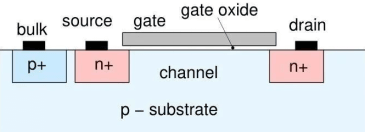
No current flow

> No current flow

By controlling the gate, we can turn on and turn off the channel. If the gate is turned on, electrons appear in the channel region.

> The thin electron layer (the channel) connects source and drain.
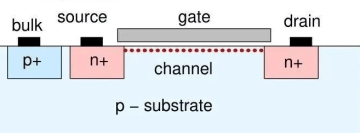
The thin electron layer (the channel) connects source and drain.

Blocking Mode

In blocking operation (gate turned off, no channel) there is a depletion region between drain and p-substrate (which is connected to source via bulk).
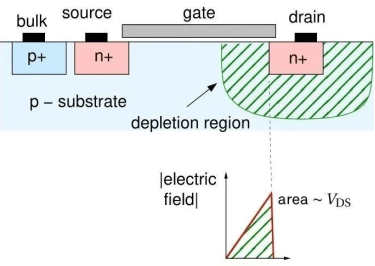
Section image

Requirements for High Blocking Voltages

High electric fields can cause avalance. However, a large area is required for high blocking voltages. Further, the depletion region must not extend into source to avoid punch-through currents.

> Need a wide depletion region
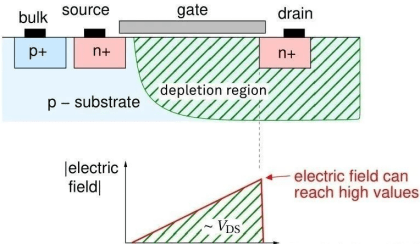
Need a wide depletion region

Impact on On-State Resistance

However, a wide MOSFET also has a long channel:
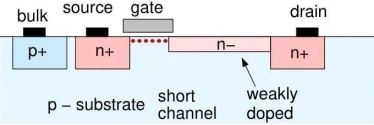
a wide MOSFET also has a long channel

This increases the on-state resistance Rpson.

Fortunately, there are better concepts.

Drain-Extended MOSFET

We can shorten the channel by introducing a lowly doped n- region.
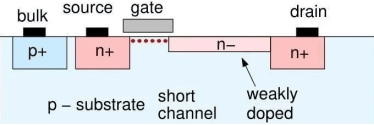
shorten the channel by introducing a lowly doped n- region

> Decreased Rpson

In blocking mode, however, the depletion region extends through the lowly doped n- region.
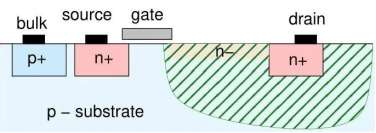
Wide depletion region, high breakdown voltage

> Wide depletion region, high breakdown voltage

Vertical DMoS

Further optimization by increasing the drain contact area:
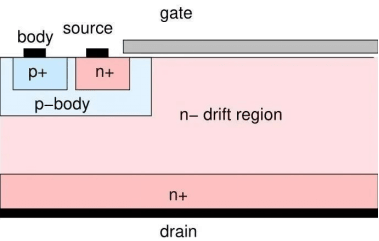
Further optimization by increasing the drain contact area:

Note: The n+ layer is much thicker than shown here. (Fabrication starts with a thick highly n+-doped wafer, on which the lowly doped n- drift region is deposited.)

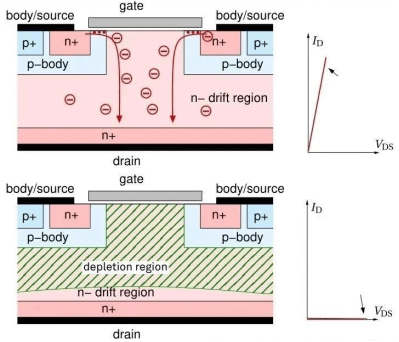
On-and Off-State
Section image

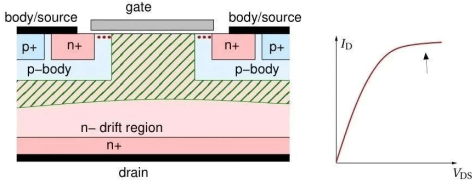
Saturation

At a certain drain-source voltage the depletion regions between p-body and n-drift regions merge (pinch-off). Then, the current does not increase anymore: saturation
Section image

This also shields the gate from high voltages.

> Gate oxide can be thin everywhere (for vertical DMOS)

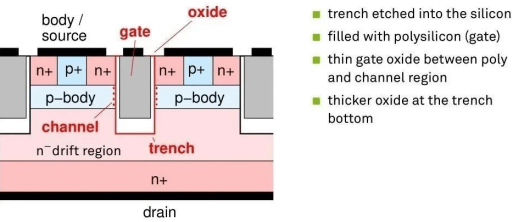
Trench MOSFET

Today, Trench MOSFETs are commonly used.
Section image

> No JFET effect anymore (pinch-off by adjacent p-bodies in planar MOSFETs)

> Higher channel density per area possible (channel now not limited by silicon surface. Trench surface can be larger.)

Capacitances

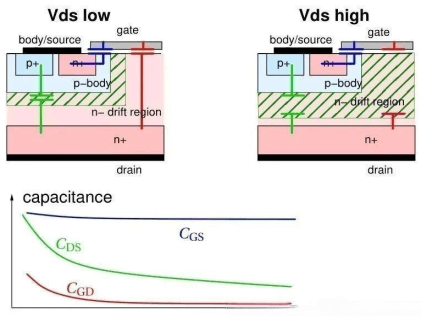
MOSFETs are unipolar devices (apart from the body diode) Switching speed is mostly determined by charging and discharging the parasitic capacitances.
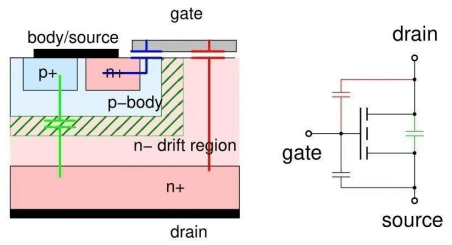
Some depend on the depletion region width, i.e. on VDS.

Some depend on the depletion region width, i.e. on VDS.

Dependence on the operating point:
Section image

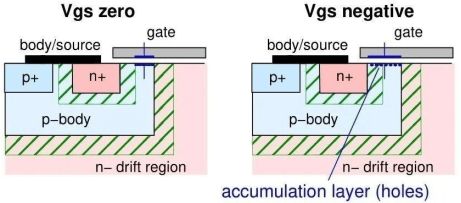
Note that for negative gate-source voltages, the input capacitance (most notably CGs increases further. This is because if VGS becomes negative, accumulation occurs in the p-body.
Section image

This accumulation layer can also enter the depletion region to n+ -source, thus widening the area contributing to CGs.


Subscribe
Previous
What Is IPM in Air Conditioner: The Component That...
Next
The Future of Electric Vehicles: SiC MOSFET Power Modules...
 Return to site
Profile picture
Cancel
Cookie Use
We use cookies to improve browsing experience, security, and data collection. By accepting, you agree to the use of cookies for advertising and analytics. You can change your cookie settings at any time. Learn More
Accept all
Settings
Decline All
Cookie Settings
Necessary Cookies
These cookies enable core functionality such as security, network management, and accessibility. These cookies can’t be switched off.
Analytics Cookies
These cookies help us better understand how visitors interact with our website and help us discover errors.
Preferences Cookies
These cookies allow the website to remember choices you've made to provide enhanced functionality and personalization.
Save