

The size of the parasitic inductance not only affects the transient voltage and current of the chip, but also affects the loss and heat of the FRD chip. Therefore, SHYSEMI wants to introduce to everyone: under different parasitic inductances, what is the influence of the reverse recovery characteristics of diodes.
1. What Is Parasitic Inductance
Parasitic inductance is essentially an inductor, which is an inductor that is not needed in the circuit but cannot be avoided. It satisfies u = L * di/dt. It is usually caused by factors such as circuit layout and components.
It parasitizes on the inductance of the PCB traces on the circuit board or other components, such as copper wires on the PCB, vias, bonding lines inside the chip, component pins, cables, etc. These parasitic inductances generally have an inductance of the order of nH.

2.Reverse recovery characteristics without parasitic inductance
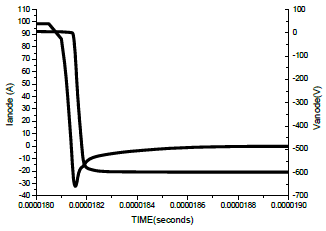
When the diode has no parasitic inductance, the reverse recovery peak current IRRM is 32.23A, the reverse recovery charge QRR is 3.06 μC, and the reverse recovery loss EOFF is 1.434 mJ. The reverse recovery current-voltage waveform without parasitic inductance is shown in Figure 1.
Under the same BV and VF conditions, the IRRM of PIN diodes and traditional CIC diodes is much higher than that of the diodes designed in this paper, as shown in Figure 2.

Without parasitic inductance, the reverse recovery parameters of the three are shown in Table 1.

As shown in Table 1, the diode designed in this paper has a reverse recovery peak current IRRM that is approximately 60% lower than the other two, a quiescent reverse recovery rate QRR that is approximately 32.2% lower than the other two, and a softness factor S that is significantly higher than the other two. At the same time, due to the larger softness factor, the trailing current is larger, resulting in its reverse recovery loss EOFF being at most approximately 14.8% higher than the other two. The reverse recovery losses of the three diodes are shown in Figure 3.

2.Low Parasitic Inductance Reverse Recovery Characteristics
Under the condition of low parasitic inductance (30nH), the reverse recovery parameters of the three types are shown in Table 2.

The reverse recovery current waveforms of the three are shown in Figure 4. As can be seen from the figure, the FRD/MUR structure designed in this paper still maintains an extremely low IRRM even with parasitic inductance, which makes all the reverse recovery data in Table 2 significantly better than those of traditional PIN or CIC diodes.

The reverse recovery losses of the three components are shown in Figure 5.

3.Reverse Recovery Characteristics of High Parasitic Inductance
Under the condition of higher parasitic inductance (80 nH), both traditional PIN and CIC diodes exhibit oscillation, as shown in Figure 6. However, the diode designed in this paper still maintains excellent soft recovery characteristics.
- (a)Traditional PINFRD/MUR
- (b) Traditional CICFRD/MUR
- (c) FRD/MUR designed in this paper

Under a higher parasitic inductance (2000 nH), the diode designed in this paper still maintains excellent reverse recovery characteristics, as shown in Figure 7. There is no oscillation or significant step voltage.

Summary
- Series parasitic inductance → Mainly affects the rate of decrease of reverse recovery current, and increases voltage spikes.
- Loop parasitic inductance → Affects the overall switching process, increasing losses and oscillations.
- Optimization methods: Reduce inductance (layout optimization, low-inductance packaging), select appropriate diodes, add buffer circuits (such as RC absorbers).
In high-frequency switching power supplies (such as Buck, Boost, and LLC resonant converters) or inverters, the influence of parasitic inductance is particularly crucial and should be given special consideration during the PCB design and component selection stages.