

Industrial control applications are fundamentally different from low-power consumer scenarios. In this field, precision power control is only part of the challenge. System-level mechanical accuracy, continuous operation, and operational safety are equally critical. As a result, testing standards for industrial IPM (Intelligent Power Module) solutions must be significantly more rigorous.
At SHYSEMI, we begin by understanding the real-world demands of industrial environments—because these demands define why certain tests are not just recommended, but essential.
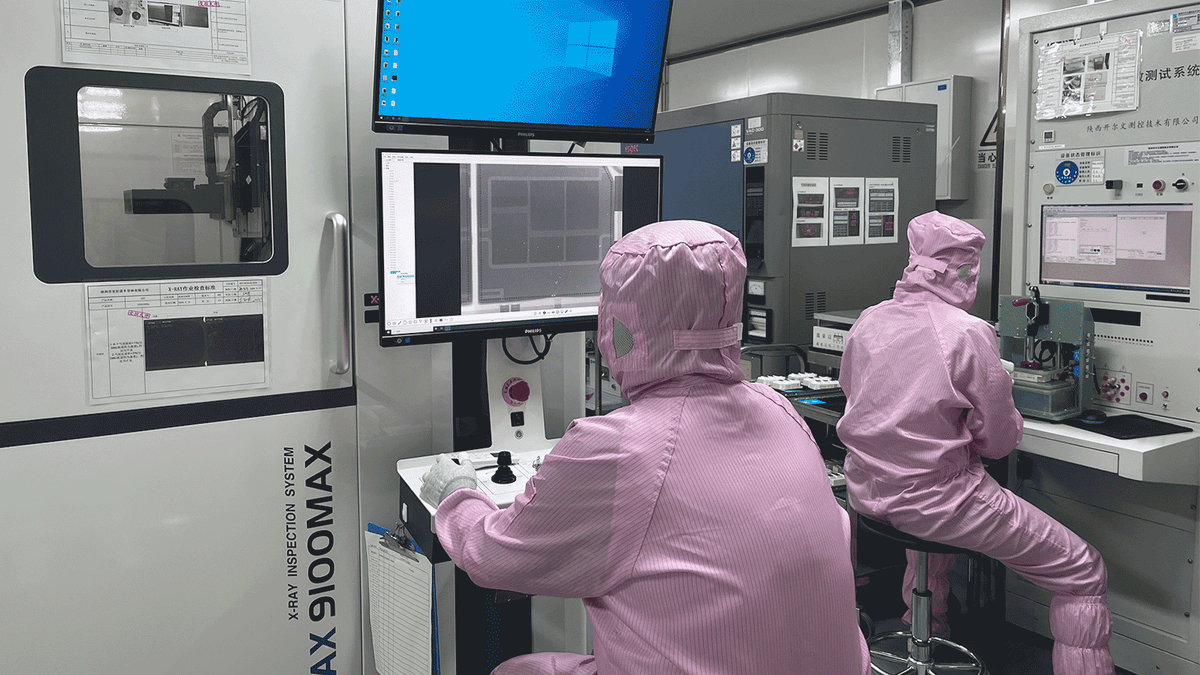
The SHYSEMI employees are inspecting the IPM module.
Core Requirements in Industrial Applications
1. High Reliability and Long Lifetime
Industrial systems require exceptionally high MTBF (Mean Time Between Failures). In continuous production lines or unmanned base stations, even a single unexpected shutdown can result in substantial financial losses.
2. Harsh Environmental Adaptability
IPMs must operate reliably under high temperature, humidity, dust, and vibration. Applications such as mining equipment or outdoor wind turbines demand strong environmental robustness.
3. Continuous Full Load and Overload Capability
Frequent motor starts and sudden stops require modules to withstand short-term overload conditions. In cranes or rolling mills, short-time overload capability is often a baseline safety requirement.
4. Comprehensive Protection Mechanisms
Fast and accurate responses to overcurrent, short circuit, and overtemperature events are essential to prevent catastrophic failure—especially in rail transit or elevator systems where personal safety is involved.
5. Electromagnetic Compatibility (EMC)
Switching noise must not interfere with surrounding equipment, and the module must resist external interference. In complex industrial environments where inverters, sensors, and communication devices coexist, EMC performance is fundamental to system stability.

1. Extreme Parameter & Safety Margin Testing
Maximum DC Bus Voltage Testing
Short-time switching tests are performed at absolute maximum ratings (e.g., 120% of rated voltage) to verify voltage tolerance and short-circuit protection effectiveness under high-voltage stress. This is critical in regions with unstable grids or in servo drive systems requiring high voltage precision.
Short-Circuit & Overcurrent Capability
The Short Circuit Withstand Time (SCWT) is verified under hard short-circuit conditions. Using an oscilloscope, the time from fault occurrence to complete shutdown must remain well below the specified SCWT (typically 5–10 μs).
For welding equipment and motor drives, this directly determines system survivability.
Repetitive Short-Circuit Testing
Multiple short-circuit events (e.g., 10 cycles) are applied under controlled conditions. After each test, static parameters such as on-state resistance are checked for drift, validating long-term robustness—especially important in aerospace and military-grade systems.
2. Thermal Performance & Power Cycling Reliability
Maximum Junction Temperature Verification
Using thermal resistance calculations or infrared imaging, junction temperature must remain within industrial IGBT limits (typically 175°C) under maximum load.
Power Cycling Testing
Modules undergo thousands of heating and cooling cycles to simulate real motor start-stop operation. Post-test comparison of switching characteristics and voltage drop reveals bond wire and solder fatigue.
For applications such as EV systems or elevators, this test reflects real operational lifespan.

EV systems
3. Dynamic Performance & Switching Loss Evaluation
Double Pulse Testing (Core Evaluation Method)
Testing must be conducted not only at room temperature and rated current but also under high temperature (e.g., 125°C), high bus voltage, and high current conditions.
This is particularly important in high-efficiency systems such as:
- Solar inverters
- UPS systems
- High-frequency induction heating equipment
Key Parameters Monitored:
- Switching Energy (Eon, Eoff, Erec)
Turn-off losses increase significantly at high temperatures. Accurate measurement is critical for high-frequency designs. - Switching Speed (dv/dt, di/dt)
Excessive dv/dt may cause EMC issues and insulation stress. In motor drives, it can induce shaft currents and reduce bearing life—an often overlooked but critical detail. - Voltage Overshoot (Vce_peak)
Caused by parasitic inductance during turn-off. It must remain within the Safe Operating Area (SOA), especially in 690V industrial systems where voltage margin is limited. - Gate Resistor (Rg) Optimization
External gate resistors must be tuned via double pulse testing to balance switching loss, voltage overshoot, and EMC performance. The optimal balance depends on application priorities—efficiency vs. EMI control.
4. Protection Function Integrity Testing
Industrial environments require fail-safe protection performance.
Overtemperature Protection
The module is heated externally or via self-dissipation until the internal temperature sensor (e.g., NTC) triggers protection. Accuracy of the shutdown threshold and fault output signal (FO) is verified.
Undervoltage Lockout (UVLO) Testing
Driver supply voltage is gradually reduced to simulate grid instability. Lockout and recovery thresholds must exhibit sufficient hysteresis to prevent oscillation near threshold levels.
Fault Handling & Auto-Recovery
After a fault event (e.g., overcurrent), behavior is tested—whether permanent latch or automatic retry. Retry timing must align with system-level control strategies, particularly in unmanned remote systems.
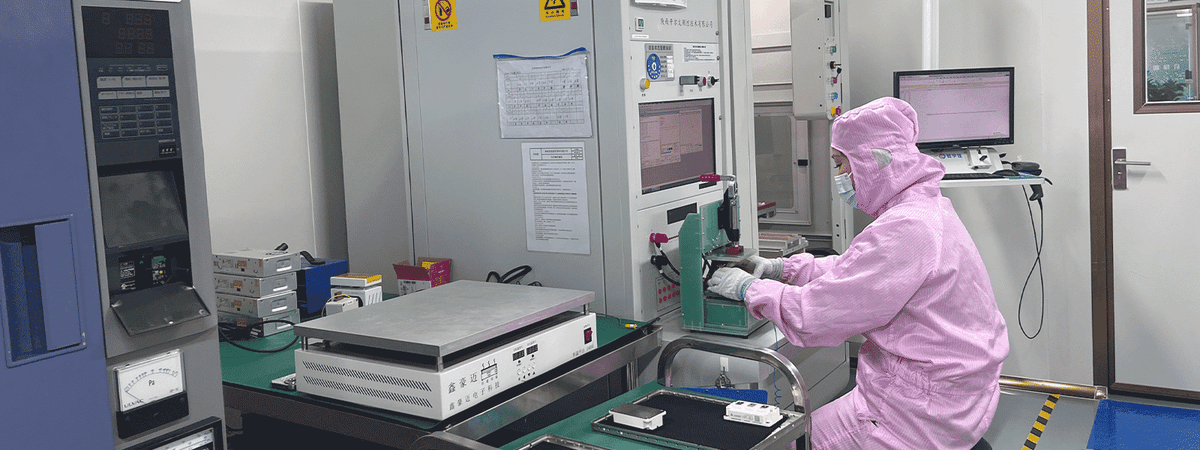
The SHYSEMI employees are testing the IPM module.
5. EMC Pre-Compliance Testing
Conducted Emissions
Using spectrum analyzers and LISN equipment, switching noise through power lines is measured. Optimization of gate resistors, snubber circuits, and PCB layout reduces emissions—helping shorten CE/FCC certification cycles.
Immunity Testing
High-frequency noise is injected into control and power lines to ensure the IPM does not mis-trigger. In workshops with large motors and welding systems, strong immunity prevents system malfunction.
6. System-Level Integration Testing
Industrial IPMs must be validated within the final controller (e.g., inverter system).
Motor Load Testing
Under full load, overload, high-speed, low-speed, and bidirectional operation. Real-time monitoring includes:
- DC bus voltage ripple
- Phase current waveform
- Module temperature rise
- Heatsink temperature
Typical Scenario Simulations:
- Servo Drives – Frequent start-stop and precision positioning (critical for robotics and CNC systems).
- Cranes & Elevators – Heavy-load startup and regenerative braking (safety-critical).
- Pumps & Fans – Long-term continuous operation (stability and efficiency equally important).
Conclusion
Testing industrial IPM modules cannot stop at “functional verification.” It must rigorously evaluate stability, reliability, and safety under extreme, harsh, and continuous operating conditions.
Three core pillars define industrial-grade validation:
- Double pulse testing
- Short-circuit withstand testing
- Thermal reliability & power cycling testing
Only through such a comprehensive and demanding testing framework can truly robust IPM solutions be qualified for industrial control applications—whether in precision servo systems or heavy-duty lifting equipment.
SHYSEMI’s industrial IPM modules are designed and validated to meet all of the above requirements.
To request a datasheet or sample evaluation, please contact our engineering team for technical support.