

Understanding the IGBT’s Role
What is the main function of IGBT in modern electronics? Simply put, it acts as a high-power switch that combines the best features of MOSFETs and BJTs.
What are IGBTs exactly? They are Insulated Gate Bipolar Transistors—devices designed for efficient high-voltage switching. Unlike standard transistors, they excel in applications demanding both power and precision.
This article compares IGBTs to MOSFETs and BJTs, explaining why they dominate in industries like renewable energy, EVs, and industrial automation.
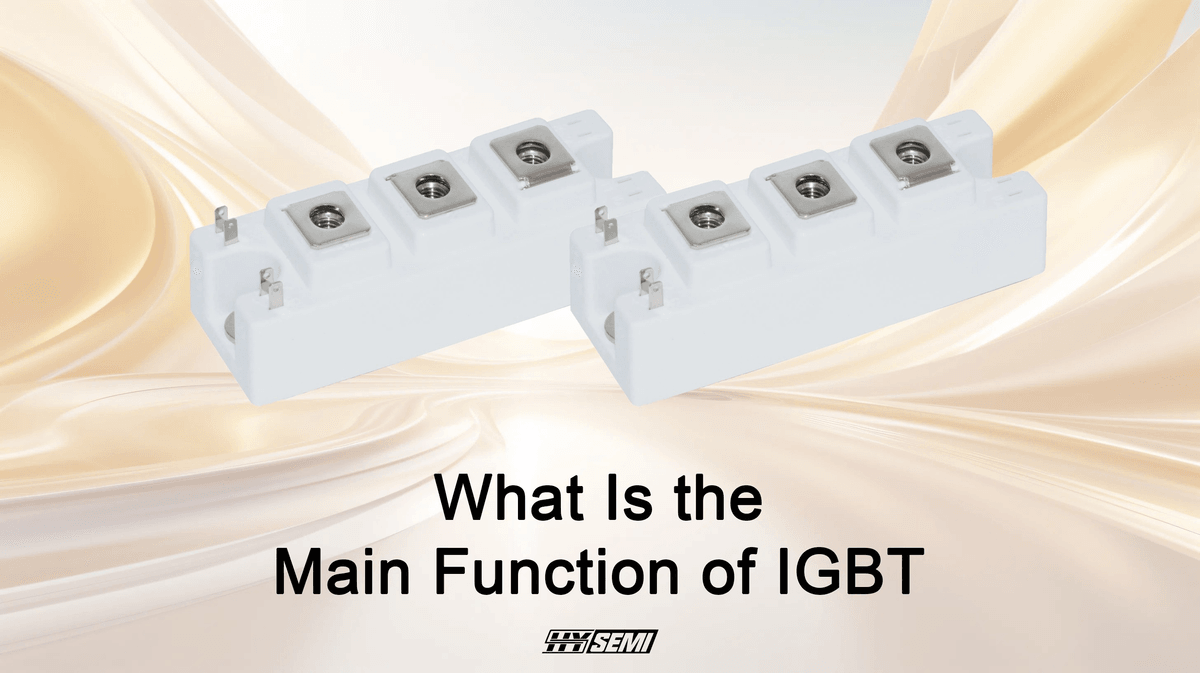
What Is IGBT and How It Works?
An IGBT’s cross-section reveals three layers:
- Gate – Controls switching (like a MOSFET)
- Collector & Emitter – Handle high current (like a BJT)
- N-drift region – Optimizes voltage blocking
IGBT module function:
- Efficiently switches high power
- Reduces heat loss
- Integrates protection features
Where IGBTs Outperform Other Transistors
- SiC IGBT module variants improve efficiency
- Handles rapid acceleration power demands
- Converts DC to AC with minimal loss
- More reliable than MOSFETs at high voltages
- IGBT discrete units control heavy machinery
- Better thermal performance than BJTs
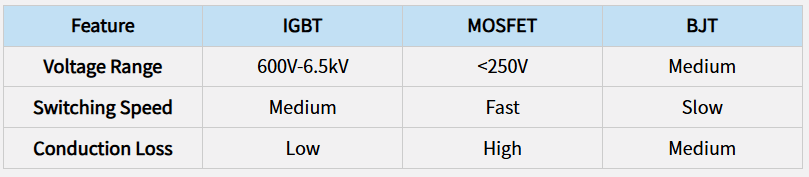
IGBT vs. MOSFET vs. BJT: Key Differences
1. Control Method
- IGBT: Voltage-controlled (like a MOSFET)
- BJT: Current-controlled
- MOSFET: Voltage-controlled but limited at high voltages
2. Power Handling
- IGBT: Best for 600V+ applications
- MOSFET: Ideal for high-frequency, low-voltage
- BJT: Older tech, less efficient
3. Switching Speed
- MOSFET: Fastest (MHz range)
- IGBT: Medium (kHz range)
- BJT: Slowest
IGBT Advantages Over Alternatives
When to Choose IGBTs
1. High-power systems (e.g., wind turbines)
2. Medium-frequency switching (e.g., motor drives)
3.Harsh environments (e.g., industrial settings)
Future of IGBTs
- Hybrid SiC IGBT modules – Boosting efficiency further
- Smarter gate drivers – Enhancing switching precision
- Lower costs – Expanding into more applications
Conclusion
What is the main function of IGBT? It bridges the gap between power and control, outperforming other transistors in critical applications.
Key takeaways:
✔ IGBTs dominate high-voltage, medium-speed switching
✔ They’re more efficient than BJTs for power apps
✔ Future SiC IGBT modules will push boundaries further
Do you have any questions or product requirements? Please send us an email at: info@shysemi.com, or simply add our WhatsApp number: +86 15361554542