

1. Introduction to Single-Phase Rectifier Bridges
A single-phase rectifier bridge is an essential semiconductor component composed of four ordinary diodes arranged in a specific bridge configuration. Its primary function is to convert alternating current (AC) into direct current (DC).
- Practical Application Example: > Consider a standard 220V AC mains power supply. Using a transformer, 220V AC is first stepped down to 15V AC. When this 15V AC power is connected to a SHYSEMI rectifier bridge, it is converted into approximately 21V DC. This DC voltage can then be further regulated and stepped down to power sensitive low-voltage electronics, such as microcontroller systems.
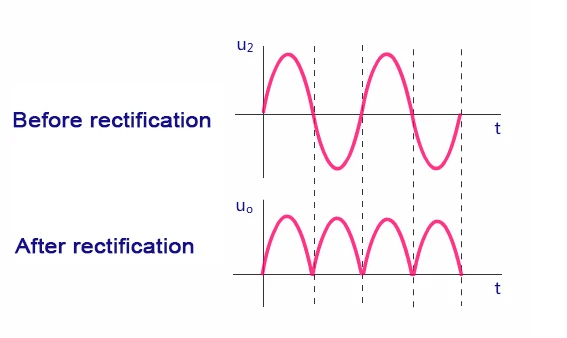
2. Working Principle of a Rectifier Bridge
The operational logic of a SHYSEMI single-phase rectifier bridge relies on the unidirectional conductivity of diodes.
Core Diode Conductance Logic:
- Forward Bias: The diode allows current to flow when positive potential is applied to the anode and negative potential to the cathode.
- Reverse Bias: The diode blocks current flow when reverse voltage is applied.
By permitting current to flow in only one direction, the rectifier bridge converts alternating AC input into pulsating DC output. During each AC cycle, only two diodes conduct simultaneously. The operation is naturally divided into two phases:
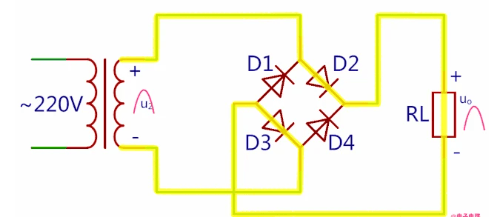
a. Positive Half-Cycle Operation: Current flows through the first pair of conducting diodes, delivering positive current to the load.
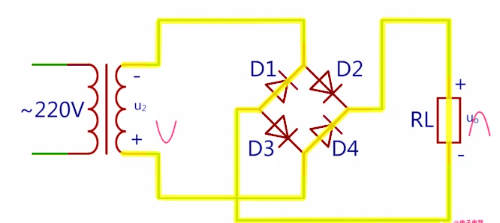
b. Negative Half-Cycle Operation: As the AC polarity reverses, the first pair cuts off, and the second pair of diodes conducts, ensuring current passes through the load in the exact same direction.
3. Output Voltage Value
The theoretical DC output voltage (Vdc) of a single-phase bridge rectifier (without a filter capacitor) can be calculated based on the RMS value of the input AC voltage (Vac):
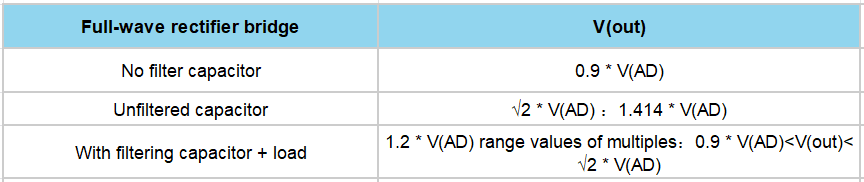
(Note: When a filter capacitor is added, the peak output voltage under no-load conditions can reach approximately 1.414 * Vac.)
4. How to Test and Detect a Rectifier Bridge
To ensure system reliability, testing SHYSEMI rectifier bridges using a multimeter is a standard maintenance practice.
4.1 Resistance Test Method
The resistance test leverages the unidirectional conductivity of diodes:
- Forward Direction: Low resistance reading (conducting).
- Reverse Direction: Infinite or extremely high resistance reading (cut off).
4.2 Voltage Drop Test Method
Using the diode test function on a digital multimeter, you can directly measure the internal diode chips of the rectifier bridge. The displayed value represents the approximate forward voltage drop (VF) of the internal junction.
Step-by-Step: Identifying Rectifier Bridge Pin Polarity
To determine the positive, negative, and AC input pins using a multimeter:
- Set the multimeter to the R × 1 k resistance range.
- Connect the black probe to any pin on the bridge rectifier.
- Test the remaining three pins with the red probe:
- Positive Output (+): If all three readings show infinity (∞), the pin connected to the black probe is the positive DC output terminal.
- Negative Output (-): If all three readings range between 4 kΩ and 10 kΩ, the pin connected to the black probe is the negative DC output terminal.
- AC Input Terminals (~): The remaining two pins are the AC input terminals.

Frequently Asked Questions (FAQ)
FAQ: What can be done if the rectified output voltage is not smooth enough?
Answer: The raw output directly rectified by a rectifier bridge is pulsating DC, which contains significant AC ripple components. To smooth out the voltage, a filtering circuit (typically using electrolytic capacitors) must be added at the output.
The filter circuit suppresses the AC ripple while maintaining the DC component. This significantly reduces the ripple factor, smooths the voltage waveform, and delivers stable DC power to downstream circuitry. High-quality SHYSEMI rectifier components combined with an optimized filter circuit ensure superior power stability for demanding applications.