

In the field of power electronics, IGBT (Insulated Gate Bipolar Transistor) serves as the core power switching device, and its performance directly determines the efficiency and reliability of the entire system. When evaluating the performance of IGBT, the switching energy parameters:
- Eon (on-state energy),
- Eoff (off-state energy),
- Ets (total switching energy)
These are the key indicators that engineers must deeply understand.
1. Why is power consumption of the switch so important?
The operation process of IGBT is essentially a continuous cycle of "on" and "off". Each switching process is not completed instantaneously. During this process, there is a brief period of overlapping of both voltage and current, which leads to switching losses (Switching Losses). These losses are dissipated in the form of heat, causing the device temperature to rise.
Excessive switching losses will:
- Reduce system efficiency: Energy is wasted on heat generation instead of being delivered to the load.
- Limit switching frequency: High-frequency switching generates more heat, forcing the system to operate at a lower frequency and affecting performance.
- Increase heat dissipation costs: Larger and more expensive heat sinks and cooling systems are required.
- Threaten device reliability: Excessive junction temperature shortens the lifespan of IGBTs and even causes instantaneous failure.
Therefore, accurately measuring and understanding Eon, Eoff and Ets is the foundation for designing efficient and reliable power electronic systems.
2. In-depth Analysis of Core Parameters
2.1 Eon (Onset Energy)
- Definition: Eon refers to the energy consumed by an IGBT as it transitions from the off state to the fully conducting state.
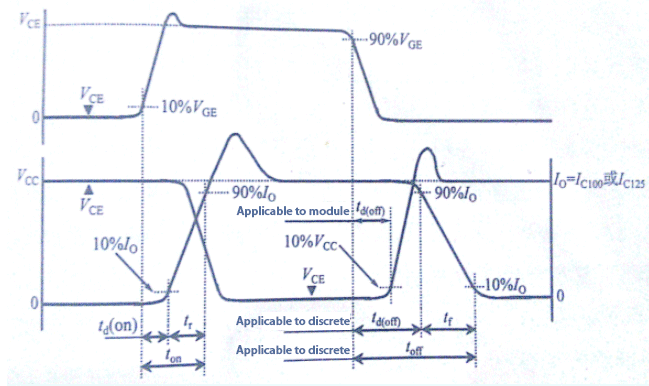
- Process Analysis: When the gate drive voltage increases, the collector current (Ic) begins to rise, but the collector-emitter voltage (Vce) does not immediately decrease. During the overlapping period of the current increase and the voltage drop, a significant turn-on loss is generated. Eon is the integral of all instantaneous powers over time during this process.
- Influencing factors: Drive resistance (Rg), gate drive voltage, bus voltage, junction temperature, load current, and the inherent characteristics of the IGBT (such as Miller capacitance).
2.2 Eoff (Turn-Off Energy)
- Definition: Eoff refers to the energy consumed by an IGBT as it transitions from the conducting state to a completely off state.
- Process Analysis: When the gate drive voltage decreases, Vce begins to rise, but Ic does not immediately drop to zero. During the overlapping period of voltage increase and current decrease, switching losses occur. Eoff is the integral of all instantaneous power over time during this process. Usually, Eoff is greater than Eon.
- Influencing factors: Drive resistance (Rg), gate drive negative voltage (-Vge), bus voltage, junction temperature, load current, and the trailing current characteristics of the IGBT.
2.3 Ets (Total Switching Energy)
- Definition: Ets refers to the total energy consumed during a complete switching cycle (on-time + off-time). Ets = Eon + Eoff.
- Practical application: When calculating the total switch loss of the computing system, Ets is the most direct parameter. The total switch power loss (P_sw) can be calculated using the formula: P_sw = Ets × f_sw (where f_sw is the switching frequency). This formula intuitively demonstrates the significant impact of the switching frequency on the system loss.
3. How to Optimize Switching Energy Consumption?
Reducing Eon, Eoff and Ets is the key to improving system efficiency. Generally, the following aspects can be considered:
3.1 Selecting the Right IGBT
IGBTs of different technologies (such as PT, NPT, FS7, IGBT7, etc.) have significant differences in switching characteristics. The new generation of IGBTs typically reduces switching losses and trailing currents by optimizing the cell structure and process.
3.2 Optimizing the drive circuit
Drive resistor (Rg): Reducing Rg can increase the switching speed and reduce the switching energy consumption, but it may cause voltage overshoot and electromagnetic interference (EMI). A trade-off needs to be considered.
3.3 Drive voltage
Increasing +Vge can slightly reduce Eon, but it will increase the risk of short circuit; applying negative voltage (-Vge) helps to more reliably turn off and reduces Eoff.

3.4 Utilizing soft-switching technology
By adopting ZVS (zero-voltage switching) or ZCS (zero-current switching) techniques in the topological structure, it is possible to significantly reduce or even eliminate the voltage/current overlap during the switching process, thereby fundamentally reducing Eon and Eoff.
3.5 Precise measurement and verification
Using high-performance power analyzers and oscilloscopes to conduct precise dual-pulse tests (DPT) is the prerequisite for obtaining accurate Eon and Eoff data. Accurate data forms the basis for all optimization efforts.
Conclusion
A thorough understanding of the switching energy parameters Eon, Eoff and Ets of IGBT is the first step towards the design of efficient power electronic systems. Only by scientifically selecting components, meticulously designing the system, and conducting precise testing can these parameters be effectively controlled and the maximum potential of the system be unleashed. During this process, choosing to collaborate with a partner like SHYSEMI, which possesses professional knowledge and abundant resources, will undoubtedly add significant weight to the success of your product.