

In the core area of power electronics systems—whether in new energy vehicle electric drives, photovoltaic inverters, or industrial inverters—IGBT performance critically depends on its gate drive circuit. A carefully optimized drive solution is the key to fully unleashing device potential and ensuring long-term system stability. This article will focus on the drive requirements of 1700V/40A IGBTs, explore key gate drive design points, and explain how to achieve improved reliability and breakthrough performance through high-performance drive technology.
1.Key Design Parameters for IGBT Gate Drives
1.1 Precise Control of Drive Voltage (VGE)
- Forward conduction voltage (VGE(on)): Typically +15V ±10%. Lower voltage increase conduction losses, while higher voltage can cause latching or gate oxide breakdown. The maximum value is generally not to exceed +20V.
- Turn-off negative voltage (VGE(off)): Applying a -5V to -10V is recommended. This significantly enhances interference immunity, suppresses false turn-on caused by the Miller plateau, accelerates turn-off, and reduces turn-off losses.
1.2 Optimizing Gate Resistor (RG) Design
Gate resistance directly impacts the "speed vs. smoothness" trade-off in switching behavior:
- A smaller RG value reduces switching losses but results in higher dI/dt and dV/dt, causing voltage spikes and EMI issues, and even inducing oscillations.
- A larger RG value suppresses overshoot and oscillation but increases switching time and losses, leading to increased temperature rise.
Recommended Practice: Refer to the device specification for initial selection, then fine-tune based on the actual switching waveform. The turn-on (Rgon) and turn-off (Rgoff) resistors can be optimized separately to balance losses and noise.
1.3 Drive Capability and Power Requirements
The driver circuit must provide sufficient peak current (IGPK = ΔVGE / RG) to achieve rapid gate charging and discharging. The driver power supply must also meet the following requirements: PAV = Qg × ΔVGE × fsw to avoid switching performance degradation due to insufficient power supply.
2.Driver Design Challenges and Countermeasures for High-Voltage Applications
Common challenges in actual high-voltage, high-current operating conditions include:
- Layout Parasitic Parameters: Long traces introduce parasitic inductance, causing ringing and overshoot, necessitating optimized layout and low-inductance design.
- Protection Mechanisms: High-speed short-circuit (SC), overcurrent (OC), and undervoltage lockout (UVLO) functions must be integrated, with response times typically less than 10μs.
- Solation Requirements: The high-side driver must provide reliable electrical isolation and withstand high-voltage surges.
To address these challenges, selecting an integrated, intelligent, dedicated driver IC can significantly improve system reliability and debugging efficiency compared to discrete solutions.
3.SHYSEMI’s High-Voltage IGBT and Driver Solutions: Boosting System-Level Performance
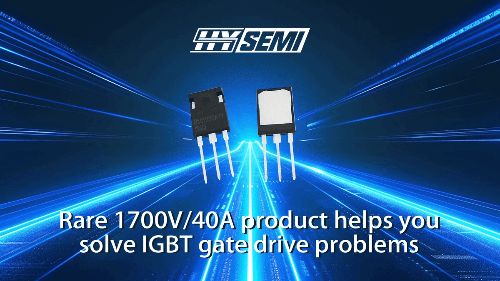
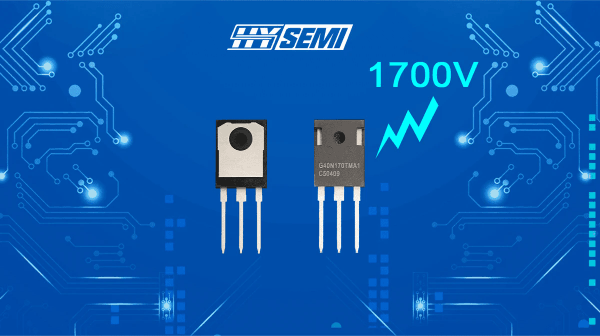
To meet the stringent driver and device requirements in high-voltage environments,Shenhuaying semiconductor has launched the SYD40N170TMA1, a 1700V/40A discrete IGBT device. Its features include:
- High withstand voltage and strong drive capability: With an insulation voltage of 1700V and a peak drive current of 40A, it is suitable for industrial-grade high-frequency, high-reliability applications.
- Excellent isolation: The TO-247 package structure offers high noise and shock resistance, adapting to transient loads and long-term operation.
- Excellent short-circuit withstand capability: With a withstand time of up to 10 seconds, it provides a sufficient response window for system backup protection, preventing damages to primary equipment due to short-circuit currents.
This device can be widely used in applications such as photovoltaic/energy storage inverters, industrial UPS, electric vehicle charging stations, and motor drives, becoming a key choice for improving overall system efficiency and reliability.

4.Conclusion
IGBT gate drive design is a crucial factor influencing system performance and reliability. Accurately controlling key parameters such as drive voltage, gate resistance, and protection mechanism are fundamental to high-voltage IGBT applications.
The use of high-performance devices such as SHYSEMI SYD40N170TMA1, combined with integrated drive solutions, can effectively simplify design complexity, improve system power density and operational stability, and help engineers meet industry challenges of higher voltage and higher reliability requirements.