

Intro: That "2500Vrms/1min" line — do you actually know what it means?
"Wang, this module is rated 2500Vrms/1min. Does that mean it can operate at 2500V?"
"Nope. That is a hipot test voltage applied between the power terminals and the case — operating voltage is far below it." Wang taps the datasheet. "On a 690V DC-bus drive, 2500Vrms is the standard choice; for a 380V system, 1500Vrms is enough."
This exchange happens in almost every design review. The insulation class is the first gate of safety for IGBTs, IPMs and power modules, yet many engineers only half-understand what it tests, how it is graded, and what each term means — some treat the test voltage as the operating voltage, some read "1min" as "every minute", and some pay extra for 4000Vrms parts in a 380V system.
This article walks through the whole picture: what the insulation class measures, how the levels are divided, what each word in 2500Vrms/1min means, and how to pick the right class for your system voltage.
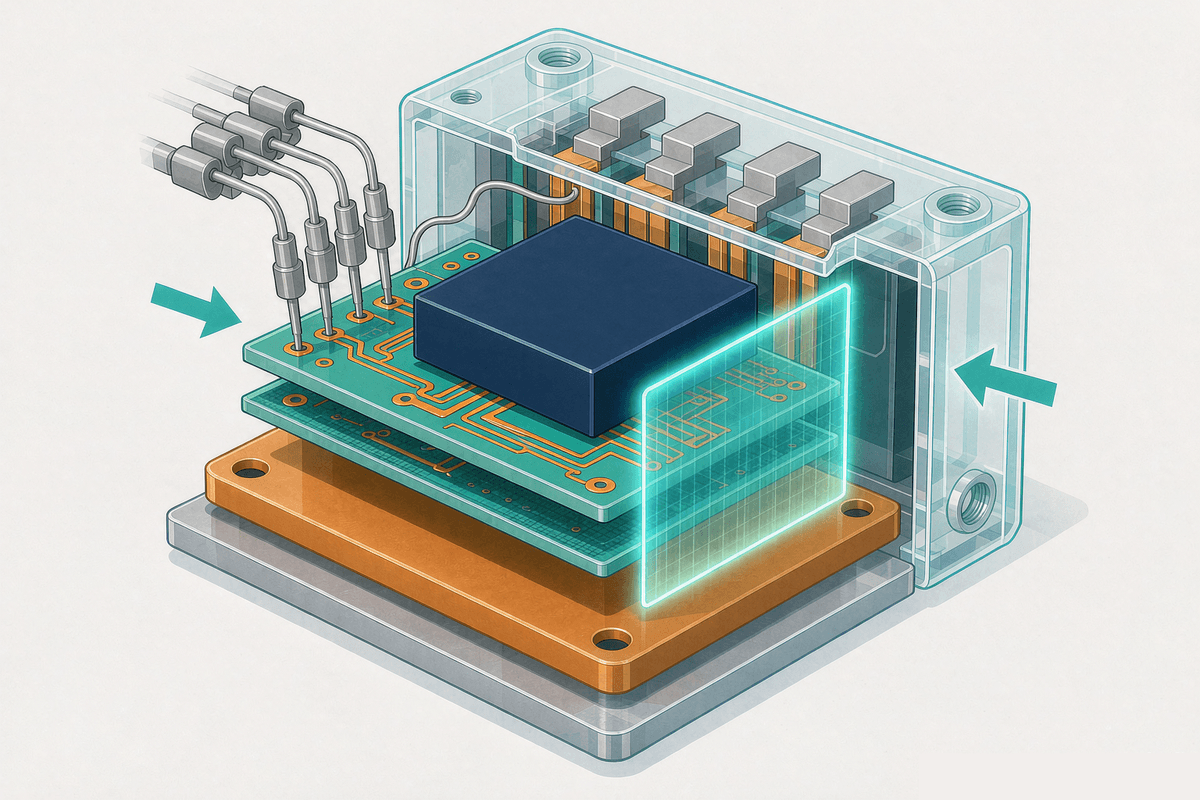
1. What Does "Insulation Class" Mean for an IGBT?
First, clear up the biggest confusion: the insulation class of an IGBT module is NOT the thermal insulation class of motor windings (Y/A/E/B/F/H/C). It is an electrical isolation withstand rating — how much voltage the main power circuit can take between itself and the case, heatsink, and drive side, without breakdown, leakage, or flashover.
The insulation does four jobs:
- Keeps high voltage out of the low-voltage control loop, protecting gate drivers and MCUs;
- Prevents a live chassis and protects personnel;
- Resists surges, spikes, and common-mode interference;
- Maintains stability in humid, dusty, or high-altitude environments.
Between which two points is the test applied?
- Primary side: IGBT collector, emitter, gate — the power loop;
- Secondary side: module baseplate, heatsink, mounting surface, signal ground;
- The insulation medium in between: DBC ceramic substrate, silicone gel, molding compound.
The hipot test applies high voltage between the power terminals and the case to qualify this insulation structure.
2. How Are Insulation Classes Graded?
The industry grades by test voltage RMS value (Vrms) plus duration, per IEC 60664, IEC 60747, UL 61800 and similar standards.
By withstand voltage (most common)
Insulation classTypical test conditionTypical applicationsBasic insulation1500Vrms / 1minLow-voltage industrial controls, small power supplies, basic 400V-class drivesStandard industrial2500Vrms / 1minGeneral-purpose drives, servo drives, PV inverters, storage, 690V systemsHigh insulation4000Vrms / 1minWind power, MV drives, mining equipment, rail transitUltra-high6000V / 10000V classHV transmission, large drives, special industrial equipment
By test duration
- 1min: type test and outgoing QC standard, qualifying long-term reliability;
- 1s / 2s: production-line quick test, voltage slightly raised to be equivalent to 1min;
- Impulse withstand (kV level): surge robustness, e.g. 12kV impulse.
By insulation structure
- Basic insulation: a single insulation layer meeting the basic withstand;
- Reinforced / double insulation: higher withstand for safety-critical equipment.
One-line summary: the higher the withstand, the thicker the insulation, the better the material and reliability — and the higher the system voltage it can support.

3. Breaking Down 2500Vrms/1min, Word by Word
This is the classic mainstream insulation spec for IGBT modules. The full meaning: apply 2500V AC RMS between the power circuit and the case for 1 minute — no breakdown, no flashover, leakage current within limits.
Vrms: RMS value, not peak
Peak = Vrms × √2. 2500Vrms corresponds to roughly 3536V peak — the module must survive about 3500V instantaneous voltage without damage.
1min: 60 seconds of continuous stress
Not "2500V every minute" — it is one continuous 60-second application. The goal is to screen out weak insulation and prevent partial micro-breakdowns or leakage from growing later, simulating long-term damp-heat and aging reliability.
Leakage current criterion
Passing requires more than "no breakdown": leakage must stay small (typically well below mA level). Excess leakage indicates a damp, contaminated, or defective insulation layer.
Engineering significance
- Fully safe for industrial systems up to AC 690V;
- Withstands motor back-EMF, switching spikes, common-mode noise;
- Meets CE, UL and other safety certifications;
- Suited to humid, dusty, high-common-mode industrial environments.
4. Matching System Voltage to Insulation Class
Rated system voltageRecommended withstand220V / 380V mains1500Vrms minimum480V / 690V industrial drives2500Vrms standard1140V mining voltage4000Vrms and above
2500Vrms is often called the "golden insulation class" for industrial power devices — the best balance of cost and reliability for systems at 690V and below.
5. Three Common Misconceptions
Misconception 1: 2500Vrms = can operate at 2500V
Wrong. 2500Vrms is a hipot test level; actual operating voltage is far lower with ample margin. Safety logic is inherently "test much higher than operate".
Misconception 2: 1min means "once per minute"
Wrong. It is the duration of a single continuous application, nothing to do with frequency or repetition rate.
Misconception 3: higher insulation is always better
Not necessarily. Higher withstand means a thicker insulation layer, higher thermal resistance, and higher cost. Match the class to the system voltage — forcing 4000Vrms into a 380V system just converts money into thermal burden.
FAQ
Is the IGBT insulation class the same thing as a motor insulation class?
No. Motor winding classes (Y/A/E/B/F/H/C) are thermal ratings based on temperature capability. The IGBT module insulation class is an electrical isolation withstand rating — how much voltage the power side can take against the case. They are completely different concepts.
What does the "1min" in 2500Vrms/1min mean?
It means applying 2500V AC RMS continuously for 60 seconds between power terminals and the case, with no breakdown, no flashover, and leakage within limits. It is the standard condition for type tests and outgoing inspection — not a per-minute repetition.
Do I need a 2500Vrms module for a 380V system?
A 380V system is fine with 1500Vrms and up. 2500Vrms is the standard fit for 480V/690V industrial drives; 1140V mining and similar systems need 4000Vrms and above. Match the class to your system voltage instead of paying for unused margin and thermal resistance.
Why does a hipot test also check leakage current?
Leakage current reveals the true state of the insulation: moisture, contamination, or process defects push it up. "No breakdown" alone is not a rigorous pass criterion — out-of-spec leakage means latent defects that will worsen over years of operation.
Summary: Start from System Voltage, Then Match the Insulation Class
The core logic in one sentence: insulation classes are graded by AC withstand RMS plus duration, and map one-to-one to system voltage levels. 2500Vrms/1min means the module survives 2500V RMS (≈3536V peak) for a full minute — the standard configuration for industrial systems at 690V and below.
Next time you see that datasheet line, do not read it as an operating voltage — it is the promise of the ceramic substrate standing between your product and an accident.
