

SHYSEMI IPM solutions integrate a thermal shutdown protection circuit designed to monitor the junction temperature of the LVIC (Low-Side Gate Driver).
When the LVIC junction temperature (Tj) exceeds the specified threshold, the TSD function is activated. The system immediately turns off the lower-arm IGBTs of all phases and outputs an FO fault signal.
Once TSD has been triggered, the IGBT junction temperature may already exceed the absolute maximum rating of 150°C. In this condition, the IPM should be replaced.
It is important to note that the monitored temperature is the LVIC chip temperature rather than the IGBT chip temperature. Due to thermal response delay, the TSD function cannot effectively respond to rapid IGBT junction temperature rise caused by severe fault conditions.
This article introduces the third protection feature: Thermal Shutdown Protection (TSD).
- Thermal Shutdown Protection (TSD) BM6337xS Series Only
01 Thermal Shutdown Protection (TSD)
SHYSEMI IPMs include an integrated thermal shutdown circuit capable of monitoring the temperature of the LVIC (Low-Side Gate Driver).
When the LVIC temperature exceeds the predefined protection threshold, the TSD function is activated.
At this point, the lower-arm IGBTs in all phases are forcibly shut down, and the FO fault signal is asserted.
02 Operating Sequence of the TSD Function
The following describes the operating sequence of the LVCC thermal shutdown protection integrated inside the LVIC.
The actions corresponding to timing points d1 through d7 are explained below.
d1: Normal Operation
During normal switching operation, collector current Ic flows while the IGBT is turned on.
d2: TSD Detection
As the LVIC junction temperature rises, thermal shutdown operation begins when the temperature reaches the TSD threshold (TSDT).
d3: IGBT Turn-Off
The lower-arm IGBTs of all phases are turned off regardless of the LIN input status.
d4: FO Fault Signal Output
The FO signal is output for a minimum duration of 180 µs while TSD remains active.
If the TSD condition lasts longer than 180 µs, the FO signal remains active until the LVIC temperature decreases below the release threshold of TSDT − TSDHYS.
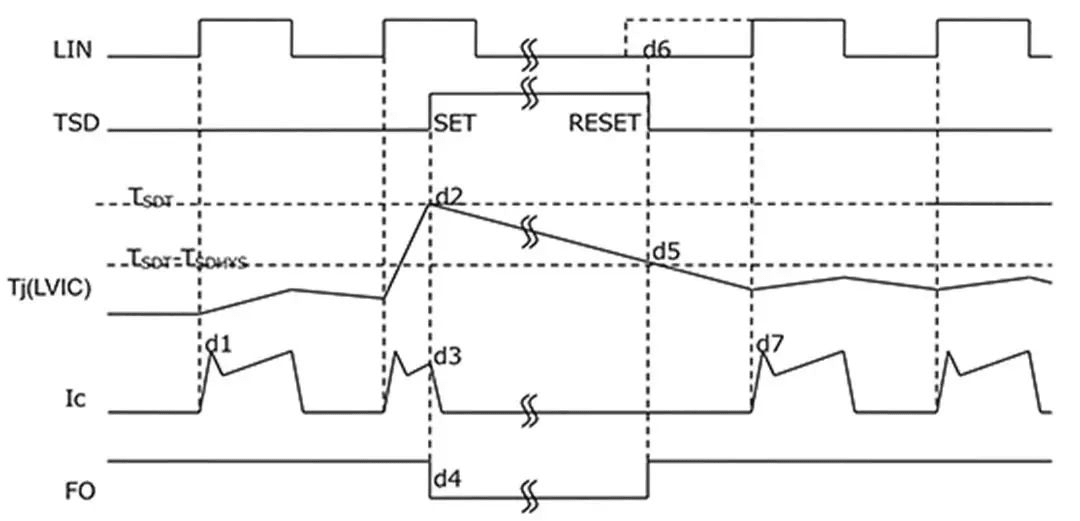
d5: TSD Release
When the LVIC junction temperature falls below the hysteresis release threshold, the TSD state is cleared.
d6: Recovery Operation
Even if LIN = High during recovery, the IGBT remains off until the next LIN rising edge is detected.
Each phase resumes normal operation independently according to its LIN input signal.
d7: Return to Normal Operation
The IGBT turns on again, and collector current Ic resumes flowing normally.
Heat Transfer Path Inside the IGBT IPM
The thermal path inside the IGBT IPM package includes two primary heat conduction routes generated by the IGBT chip:
- Heat transfer through the bonding wires to the LVIC chip
- Heat dissipation through the die pad, backside thermal pad, heatsink, and finally back into the package resin
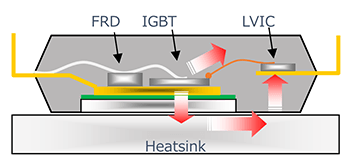
Understanding these thermal paths is critical for effective thermal management and reliable inverter system design.
Important Design Considerations
- If the TSD function is activated and an FO fault signal is generated, system operation should be stopped immediately to avoid abnormal operating conditions.
- If shutdown is caused by cooling system failure, such as heatsink detachment or cooling fan malfunction, the IGBT junction temperature may exceed the 150°C absolute maximum rating. In such cases, the IPM must be replaced.
- The monitored temperature corresponds to the LVIC chip, not the IGBT chip itself. Therefore, the TSD function cannot respond fast enough during rapid junction temperature rise caused by conditions such as motor lock, stall current, or severe overcurrent events.
- TSD should not be considered a substitute for overcurrent protection or short-circuit protection. A complete motor drive protection strategy should combine SCP, UVLO, thermal design optimization, and system-level fault management.
What Is the BM6337xS Series?
The BM6337xS series is ROHM’s third-generation 600V IGBT Intelligent Power Module (IPM) platform designed for DC-to-three-phase AC inverter applications.
These IPMs are widely used to drive small- and medium-power motor systems in home appliances, industrial equipment, and inverter-based control applications.
Developed by ROHM Semiconductor, the BM6337xS series integrates IGBTs, gate drivers, and multiple protection functions into a compact module, helping simplify inverter design while improving system reliability and thermal performance.
Today, SHYSEMI has also mastered this IPM technology platform.
Its SYIM15S60 series delivers performance comparable to leading Japanese solutions such as Mitsubishi PS21964 and Fairchild FSBB series IPMs.
Key advantages of the SYIM15S60 series include:
- Advanced IMS (Insulated Metal Substrate) thermal dissipation design
- Fast short-circuit protection response
- High integration for compact motor drive systems
- Optimized cost-performance ratio for mass production applications
- Stable supply backed by SHYSEMI’s in-house manufacturing capability
With competitive electrical performance and improved cost efficiency, the SYIM15S60 series has become a mainstream alternative to traditional Japanese IPM solutions in inverter motor drive applications.