We design and manufacture semiconductor chips, discrete power devices, and power modules for your products.
Less Energy
More Efficiency
  • Home
  • Products 
    • IPM
    • IGBT Modules
    • IGBT Discretes
    • IGBT Chips
    • SiC
    • FRD(MUR)
    • Bridge Rectifier
  • Application 
    • New Energy Vehicle
    • Home Appliance
    • Energy Storage
    • Industrial Equipment
    • Data Centers
  • Technology
  • Our Teams
  • Blog
  • Contact Us
  • …  
    • Home
    • Products 
      • IPM
      • IGBT Modules
      • IGBT Discretes
      • IGBT Chips
      • SiC
      • FRD(MUR)
      • Bridge Rectifier
    • Application 
      • New Energy Vehicle
      • Home Appliance
      • Energy Storage
      • Industrial Equipment
      • Data Centers
    • Technology
    • Our Teams
    • Blog
    • Contact Us
Sample Request
We design and manufacture semiconductor chips, discrete power devices, and power modules for your products.
Less Energy
More Efficiency
  • Home
  • Products 
    • IPM
    • IGBT Modules
    • IGBT Discretes
    • IGBT Chips
    • SiC
    • FRD(MUR)
    • Bridge Rectifier
  • Application 
    • New Energy Vehicle
    • Home Appliance
    • Energy Storage
    • Industrial Equipment
    • Data Centers
  • Technology
  • Our Teams
  • Blog
  • Contact Us
  • …  
    • Home
    • Products 
      • IPM
      • IGBT Modules
      • IGBT Discretes
      • IGBT Chips
      • SiC
      • FRD(MUR)
      • Bridge Rectifier
    • Application 
      • New Energy Vehicle
      • Home Appliance
      • Energy Storage
      • Industrial Equipment
      • Data Centers
    • Technology
    • Our Teams
    • Blog
    • Contact Us
Sample Request
We design and manufacture semiconductor chips, discrete power devices, and power modules for your products.

Simulation Analysis of Diode Reverse Recovery Characteristics

SHYSEMI: Simulation Analysis of Diode Reverse Recovery Characteristic

Many circuits can be used to test the reverse recovery time characteristics of diodes, such as boost and single-ended flyback, etc. Therefore, the first step is to build a simulation circuit. However, the prerequisite is that the entire circuit needs to operate in a discontinuous working state, so that the conditions of circuit current and voltage can be controlled to analyze the characteristics of diode reverse recovery. Otherwise, it will be affected by parameters outside the circuit.
Section image

The simulation result shows that the current value of diode D1 is as shown in Figure 1.
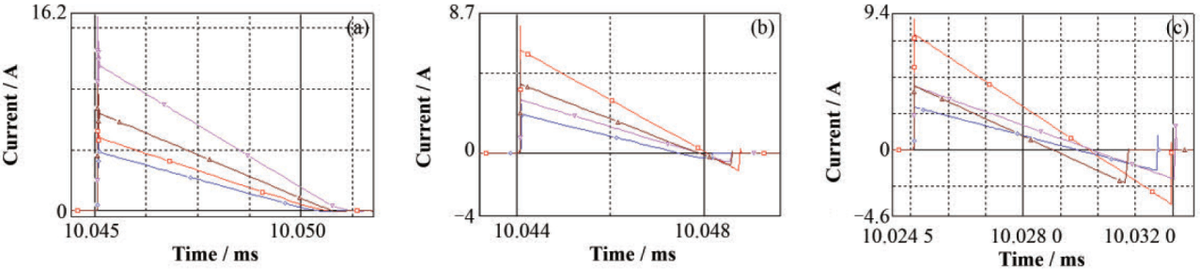
Simulation results of SIC(a), RS3M(b), and S5M(c) diodes

Figure 1 Simulation results of SIC(a), RS3M(b), and S5M(c) diodes

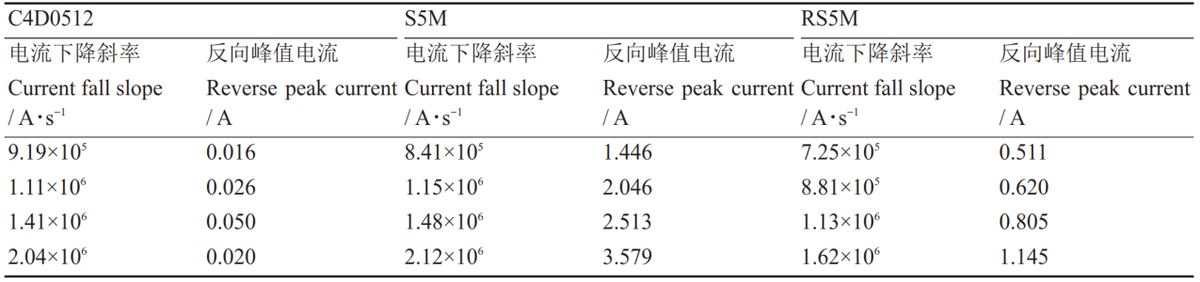
Based on the results of the diode simulation, they are summarized in Table 1. Table 1 indeed shows that the SIC diode has no reverse recovery current. The relationship between the current decay slope and the reverse peak current can be obtained as shown in Figure 2.

The following table summarizes the simulation results of C4D0512, S5M, and RS5M.
Phase-shifted Full-Bridge Simulation Circuit (a) and Results (b)

Table 1: The relationship between the slope and reverse peak current

Section image

Figure 2 Phase-shifted Full-Bridge Simulation Circuit (a) and Results (b)

The diode was simulated in the full-bridge phase-shift conversion circuit, as shown in Figure 3(a). Due to the limitation of the number of devices in the Pspice simulation conditions, the output units could only be set to 4 groups. To simulate the actual working condition of the high-voltage charging power supply, the output was set to 2000V and 500mA. From the simulation result figure 3(b), it can be seen that under the same working conditions, the diode operates in reverse. The output was set to 2000V and 500mA. Through the difference in the simulation characteristics, the peak value and slope of the reverse recovery current of the diode do indeed conform to the relationship between the slope and reverse peak current in Table 1.

Two tables, Table 2 and Table 3, were obtained respectively based on the data from the diode's datasheet and the diode's simulation results. According to equations (1) to (3), the power loss of the diode in different states was calculated respectively. By integrating these data, the power of the diode was analyzed.

Section image

Table 2 Diode Parameters

Section image

Table 3 Statistics of Diode Power Loss

Based on the above analysis, the S5M is an ordinary diode and is not suitable for high-frequency rectification. Although the forward conduction voltage of RS3M is lower than that of C4D05120E, due to the much longer reverse recovery time and reverse recovery current of RS3M compared to SIC diodes, the overall loss is also greater than that of C4D05120E. In the discontinuous Boost test circuit, C4D05120E basically has no reverse recovery time, but the reverse recovery time still exists in the simulation circuit.

Therefore, other conditions in the circuit also affect the reverse recovery characteristics. Through comparative analysis, the two important parameters of diodes, namely the forward conduction voltage and the reverse recovery characteristics, can be used as the basis for diode selection. For high-voltage and low-current diodes, the reverse recovery characteristics are more important. Therefore, the SIC diode is selected as the output rectifier diode for the power supply.

Subscribe
Previous
SHYSEMI: How to Improve IGBT Efficiency in Motor Drives
Next
Measurement Report of 50kV High Voltage Power Supply...
 Return to site
Profile picture
Cancel
Cookie Use
We use cookies to improve browsing experience, security, and data collection. By accepting, you agree to the use of cookies for advertising and analytics. You can change your cookie settings at any time. Learn More
Accept all
Settings
Decline All
Cookie Settings
Necessary Cookies
These cookies enable core functionality such as security, network management, and accessibility. These cookies can’t be switched off.
Analytics Cookies
These cookies help us better understand how visitors interact with our website and help us discover errors.
Preferences Cookies
These cookies allow the website to remember choices you've made to provide enhanced functionality and personalization.
Save
