

1. Executive Summary
Traditional fish pond aerator pumps rely primarily on discrete component drives running at a fixed, constant speed. Operating in harsh outdoor conditions—such as high humidity, heavy condensation, drastic day-night temperature fluctuations, and unstable rural power grids—these legacy systems frequently suffer from motor burnout, nuisance tripping, overcurrent shutdowns, and excessive energy consumption.

To address these pain points, SHYSEMI introduces an industrial-grade IPM (Intelligent Power Module) solution in an SDIP26 package tailored specifically for aerator pumps. By integrating power inverters, gate drivers, and comprehensive protection circuitry into a single module, this solution eliminates the need for bulky discrete layouts. Designed for three-phase aerator pumps up to 1.5kW (including paddlewheel, impeller, and surge types), it enables variable frequency drive (VFD) control, high energy efficiency, exceptional moisture resistance, and maintenance-free operation.
2. Industry Challenges & Technology Comparison
2.1 Drive Architecture Comparison
3. System Architecture & Internal Topology
3.1 System Block Diagram
The aerator drive system utilizes a four-tier closed-loop control architecture to ensure precise regulation and robust stability for smart aquaculture:
- Perception Layer: Comprises dissolved oxygen (DO) sensors, temperature sensors, and current/voltage sampling units to monitor water quality and real-time electrical status.
- Control Layer: A general-purpose MCU processes sensor inputs and runs Space Vector Pulse Width Modulation (SVPWM) algorithms to output precise speed control signals.
- Power Drive Layer: The SHYSEMI IPM serves as the core execution unit, managing signal amplification, three-phase inversion, real-time diagnostics, and fault protection.
- Actuation Layer: A three-phase AC induction or permanent magnet motor drives the aerator pump at variable speeds based on the IPM’s output.
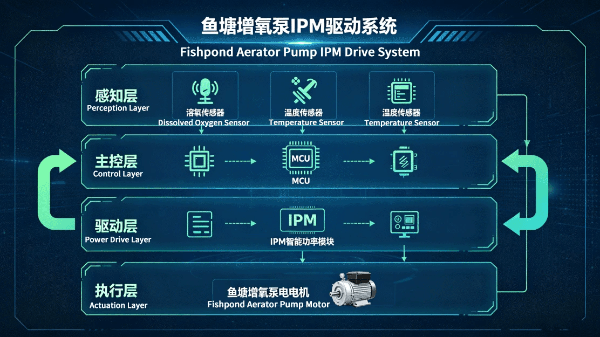
Fishpond Aerator Pump IPM Drive System
3.1 IPM Internal Topology
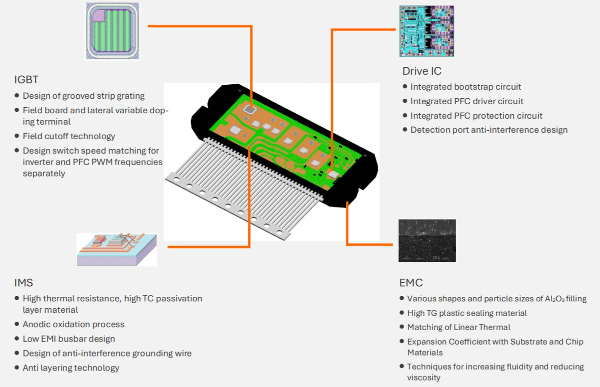
The SYIM15S60 IPM features a highly integrated monolithic topology that eliminates external power components by housing three core blocks:
- Power Topology: Integrates a 6-pack IGBT bridge with 6 fast-recovery freewheeling diodes (FRDs), forming a complete three-phase full-bridge inverter circuit for bi-directional motor control and variable frequency sequencing.
- Driver Topology: Integrates high-voltage gate driver ICs (HVICs) and bootstrap diodes, eliminating external gate drive circuitry and mitigating gate ringing or switching oscillations.
- Protection Topology: Features built-in Undervoltage Lockout (UVLO), Short-Circuit Protection (SCP), Thermal Shutdown (TSD), an integrated NTC thermistor for temperature monitoring, and a fault output pin (VFO).
4. Product Selection & Key Specifications
4.1 Part Number Selection
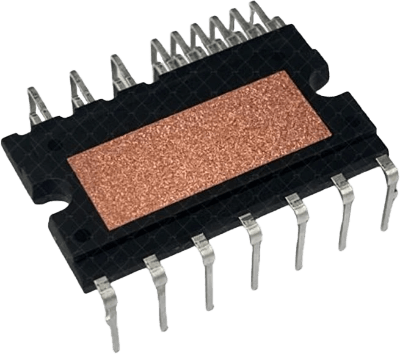
- Standard Recommendation: SHYSEMI SYIM15S60 (SDIP26 Industrial Intelligent Power Module).
- Application Target: Optimized for three-phase motor drives up to 1.5kW, offering seamless Pin-to-Pin replacement for mainstream imported modules.
4.2 Key Technical Specifications
5. Core Value Propositions
- Compact Hardware & Streamlined Manufacturing: Replacing dozens of discrete components with a single IPM simplifies PCB layout, cuts assembly steps, and lowers BOM costs. The Direct Bonded Copper (DBC) substrate provides excellent thermal conductivity, minimizing the need for bulky heatsinks and boosting production yields.
- Five-Fold Hardware Protection: Built-in UVLO, nanosecond-level short-circuit protection, overcurrent limits, thermal shutdown, and real-time NTC tracking eliminate common field failures like rotor-lock motor burnouts and voltage drop faults.
- Variable Frequency Energy Savings: Operating at up to 20kHz PWM frequency, the module supports advanced SVPWM vector control. Adjusting aerator speed dynamically based on dissolved oxygen levels and temperature avoids the waste of constant full-load running, yielding documented energy savings of 15% to 25%.
- Industrial-Grade Ruggedness: Engineered with optimized creepage/clearance distances and high insulation ratings, the module withstands harsh outdoor conditions like high moisture, dust, and rapid condensation. It passes rigorous thermal cycling, vibration, and accelerated life testing (ALT).
- Secure Supply Chain & Cost-Efficiency: With wafer fabrication, packaging, and testing fully controlled in-house, our modules offer drop-in compatibility with international brands without the premium pricing or long lead times, stabilizing your production pipeline.
6. Hardware Design & Debugging Guidelines
6.1 Peripheral Layout Best Practices
- Minimalist Bill of Materials: The peripheral circuit requires only basic auxiliary power supplies, decoupling capacitors, signal current-limiting resistors, and a fault pull-up resistor. No external gate drivers or complex bootstrap circuits are needed.
- PCB Routing Optimization:
- Visually isolate high-current power traces from low-voltage signal traces, running them in separate zones to eliminate switching noise coupling and gate ringing.
- Implement a single-point grounding (star ground) strategy for the power ground (PGND) and signal ground (SGND) to prevent ground loop noise.
- Ensure proper thermal interface material (TIM) coverage beneath the module for optimal heat dissipation to the thermal sink.
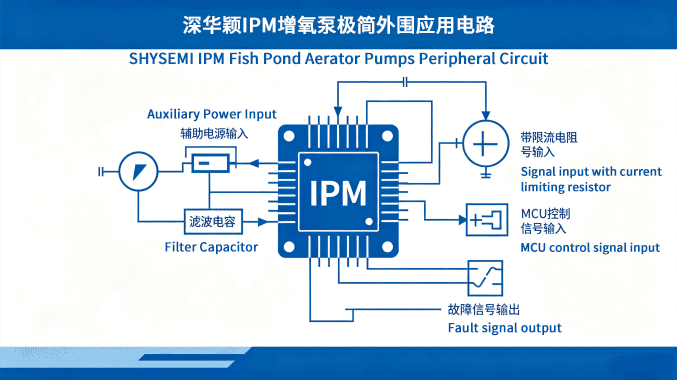
SHYSEMI IPM Fish Pond Aerator Pumps Simple Peripheral Application Circuit
The control interface easily pairs with wireless communication modules (4G/Wi-Fi), allowing OEMs to add remote telemetry features such as app-based scheduling, automated oxygen-level throttling, over-the-air (OTA) diagnostics, and cloud-based fault alerting.
7. Target Applications & Market Value
- Compatible Equipment: Paddlewheel aerators, floating impeller aerators, submersible surge aerators, and aquaculture water circulation pumps.
- Value for OEMs: Accelerates time-to-market, simplifies assembly logistics, reduces factory defect rates, and lowers overall development costs.
- Value for Commercial Farms: Lowers utility bills via smart power scaling, prevents catastrophic crop loss from sudden oxygen depletion, and decreases manual inspection overhead through maintenance-free reliability.

Send an email for more information:info@shysemi.com
8. Technical Frequently Asked Questions (FAQ)
Q: How do we prevent moisture and condensation on the driver board in high-humidity outdoor environments?
A: PCBA assemblies should undergo conformal coating (spray or selective dip) or potting encapsulation, focusing on the high-voltage traces and IPM pins to block moisture ingress and leakage paths. Mechanically, the enclosure should be positioned away from direct water spray zones. Developers should also utilize the IPM’s internal NTC thermistor to program firmware safeguards, such as restricting cold-starts during sub-zero dew points or down-throttling during high-temperature ambient spikes.
Q: What are the critical component considerations when designing the peripheral circuit?
A: 1. The auxiliary power supply must be stable with minimal ripple; voltage fluctuations must be kept strictly within the IPM’s operating window to prevent false UVLO trips or overvoltage damage.
2. Logic input lines from the MCU must feature series current-limiting resistors to suppress turn-on current spikes. The fault output pin (VFO) requires a properly sized pull-up resistor to maintain stable logic signaling and avoid nuisance fault triggers.
3. High-voltage DC link decoupling capacitors must be placed as close as possible to the IPM's $P$ and $N$ power terminals. Minimizing this loop inductance suppresses high-frequency voltage spikes during switching transitions and significantly improves electromagnetic compliance (EMC).
Q: What is the recommended procedure for first-time power-up and parameter tuning?
A: Always follow a staged power-up sequence: test the low-voltage control logic first without high voltage applied, verify that the PWM gate signals are correct, and then gradually ramp up the high-voltage DC bus under a no-load condition before connecting a motor. We recommend setting the PWM carrier frequency between 15kHz and 20kHz to strike an optimal balance between switching losses and acoustic noise. Ensure that overcurrent and stall-protection software thresholds are calibrated precisely to trigger the IPM’s hardware shutdown in milliseconds, leaving safe design margins for the 1.5kW maximum power rating.