

For Electric Vehicle (EV) owners, winter driving brings two major pain points: significant driving range reduction and inefficient cabin heating in cold weather. As the critical system designed to address these challenges, the performance of the EV heat pump air conditioner heavily relies on the component selection inside its core unit—the Compressor Controller.
What Triggers the Shift from IGBTs to SiC MOSFETs in EV Heat Pumps?
Traditional Internal Combustion Engine (ICE) vehicles rely on wasted engine heat to warm the cabin. Lacking this "natural heat source," battery electric vehicles (BEVs) have turned to heat pump systems as the mainstream solution. By moving thermal energy from the ambient air into the cabin, heat pumps consume only about one-third of the energy used by traditional PTC resistive heaters, significantly preserving winter driving range.
However, the performance ceiling of a heat pump is entirely dictated by its compressor controller. The controller must drive the compressor motor with high precision, maintaining stable power output across a wide range of temperatures and rotational speeds.
Historically, IGBTs (Insulated Gate Bipolar Transistors) were the default power semiconductors for these controllers. But as market demands for longer driving ranges and superior low-temperature performance intensify, the inherent performance bottlenecks of IGBTs have become increasingly apparent.
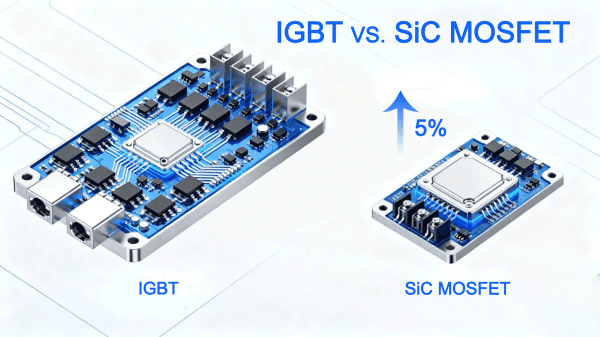
SiC MOSFET vs. IGBT: 6 Core Advantages Solving EV Heating Pain Points
Compared to legacy Silicon-based IGBTs, Silicon Carbide (SiC) materials offer superior intrinsic properties. These physics-level advantages allow SiC MOSFETs to deliver outstanding performance in heat pump compressor controllers, summarized in six core value propositions:
1. Extended Driving Range via Drastically Reduced Power Loss
SiC MOSFETs cut conduction and switching losses down to approximately 1/5 of what an IGBT consumes, drastically minimizing energy waste inside the controller. Field applications demonstrate that integrating SiC devices into heat pump systems can boost overall EV driving range by 5% to 8%, with the most pronounced benefits observed during winter heating scenarios.
2. High Stability in Sub-Zero Climates
In extreme northern winters where temperatures plummet below -20°C (-4degF), IGBTs often suffer from increased on-resistance ($R_{DS(on)}$) and sluggish cold-starts. In contrast, SiC MOSFETs maintain excellent characteristics at ultra-low temperatures, ensuring the heat pump starts efficiently and eliminates winter heating failures.

3. High-Precision Temperature Regulation at Low Speeds
Heat pump systems frequently operate the compressor at low rotational speeds during moderate thermal conditions.
Thanks to faster switching speed and improved dynamic response, SiC MOSFETs enable more precise motor speed regulation, resulting in:
- Smoother cabin temperature control
- Improved thermal comfort
- Reduced temperature fluctuation
4. Robust Thermal Resilience under High-Load Demands
When a vehicle is exposed to scorching summer heat, temperatures spike across the battery pack and electronic control systems, degrading the current-carrying capability of traditional IGBTs. Conversely, SiC MOSFETs boast exceptional high-temperature resilience—with a maximum operating junction temperature ($T_j$) up to 175°C. This allows them to securely handle high-load startups, maximizing system reliability.
5. Superior NVH Performance for Quiet Cabin Comfort
SiC MOSFETs support switching frequencies above 20kHz, significantly higher than the typical 10kHz limit of IGBTs.
Higher switching frequency provides several NVH (Noise, Vibration, and Harshness) advantages:
- Avoids audible noise frequency ranges
- Reduces motor harmonic interference
- Enables quieter air conditioning operation
- Improves overall cabin comfort
6. Compact Form Factor Driving Vehicle Lightweighting
SiC MOSFETs offer significantly higher power density than traditional IGBTs.
At the same power level, SiC devices can reduce component size to approximately one-third that of equivalent IGBT solutions. This allows:
- Smaller compressor controller designs
- Reduced system weight
- More flexible vehicle packaging
- Lower overall vehicle energy consumption
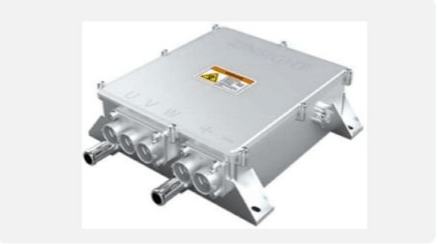
Top-Tier SiC Power Solutions for Automotive HVAC Compressors
has been committed to matching high-performance semiconductor technologies with real-world automotive applications. To address the evolving requirements of EV heat pump compressor controllers, the company has developed a comprehensive portfolio of SiC MOSFET products optimized for replacing traditional IGBT solutions.
Built on advanced Silicon Carbide technology, SHYSEMI offers SiC MOSFET devices in:
- 650V
- 1200V
- 1700V
These voltage platforms fully support the power requirements of mainstream EV heat pump compressor systems.
- Key device advantages include:
- Low RDS(on)
- High switching frequency capability
- Wide operating temperature range
- Excellent thermal stability
- High power density
These performance characteristics directly support the six application advantages discussed above, making SHYSEMI SiC MOSFETs an ideal solution for next-generation EV thermal management systems.
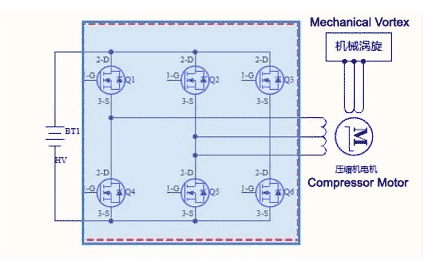
The company has established long-term partnerships with multiple well-known automotive manufacturers, including major Chinese EV brands. (Note: Due to Non-Disclosure Agreements regarding custom automotive solutions, please contact our engineering team directly for specific part numbers and datasheets).
Conclusion
As the New Energy Vehicle (NEV) industry accelerates toward efficiency, energy conservation, and rugged reliability, transitioning from IGBTs to SiC MOSFETs is no longer optional—it is an inevitability. SHYSEMI will continue to bridge advanced technology with application-driven R&D, delivering premium SiC MOSFETs, SiC power modules, and comprehensive technical support to the automotive supply chain. Together, we drive the next generation of e-mobility.