

The Battery Management System (BMS) is the "brain" of a high-voltage battery pack. Its primary function is the intelligent management and maintenance of battery units—preventing overcharge and overdischarge, extending service life, and monitoring battery status in real-time.
Why NEVs Require Advanced Battery Management:
1. Safety Requirements: Without a BMS, batteries pose significant risks of thermal runaway, fire, or explosion. Every battery has specific operating constraints: charge/discharge current limits, temperature ranges, and cell voltage limits. A BMS ensures the battery stays within its "Safe Operating Area" (SOA) rather than drifting into "critical zones" where the probability of accidents spikes.
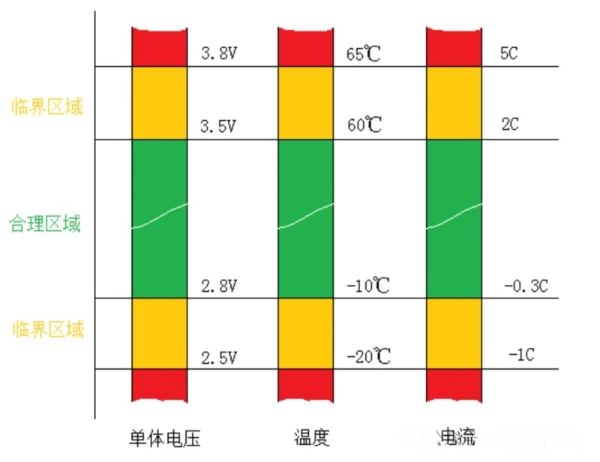
2. Extending Battery Life: Batteries achieve their maximum cycle life when operated within their "Optimal Zone." Operating in critical zones significantly degrades chemical stability. The BMS provides alerts and corrective actions to return the battery to its optimal state.
3. Maximizing Effective Energy Storage: Since individual cells have limited energy, they are connected in series to form a string. Due to manufacturing variances, cells never have identical energy levels.
- During discharge: The process must stop when the weakest cell reaches the lower voltage limit, even if others still have energy.
- During charging: The process must stop when the strongest cell reaches the upper voltage limit, even if others are not full.
- The Goal: The BMS uses Cell Balancing to minimize these variances, making the "Effective Energy Storage" as close to the "Theoretical Capacity" as possible.
4. Estimating Remaining Energy: The BMS calculates the State of Charge (SOC) to predict the vehicle's remaining driving range (Range Estimation).
Battery System Functional Overview
A BMS generally consists of Terminal Modules (Slave Boards), a Core Control Module (Master Board), and a Display/Communication Interface:
Terminal Modules (Slave Boards)
These interface directly with the cells to perform:
- Precision cell voltage measurement.
- Cell temperature monitoring.
- Cell Balancing (Energy Equalization).
- Local thermal management.
- CAN Bus communication.
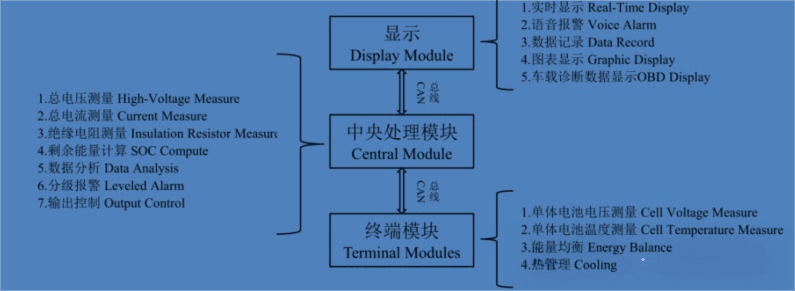
Core Control Module (Master Board)
As the "central processor," it performs:
- Total pack voltage and current measurement.
- Insulation resistance monitoring (leakage detection).
- SOC (State of Charge) & SOH (State of Health) calculation.
- Data analysis and multi-level alarm triggering.
- Protection control (Relay management).
Display & Interaction Module
- Real-time data visualization.
- Voice/Visual alarms for faults.
- Data logging, history recording, and trend charting.
In-Depth Functional Analysis
1. Cell Voltage Measurement
Voltage is the most critical parameter for characterizing a battery. While SOC has a non-linear relationship with voltage, monitoring it provides a baseline for charge status and safety protection. In high-end systems, voltage is combined with current and temperature data to produce a highly accurate, corrected SOC.

2. Temperature Management
Temperature monitoring is vital because excessive heat leads to internal short circuits. Between the anode and cathode materials is a plastic separator. If the temperature rises too high, the separator softens and can be pierced by dendrites, causing a massive short circuit and potential explosion.
- Method A: Distributing a fixed number of probes throughout the "battery cluster."
- Method B: Placing sensors directly on the terminal connectors of every cell for individual monitoring.
3. Protection Control
Modern BMS protection logic includes Overcharge (OVP), Overdischarge (UVP), Overcurrent (OCP), and Overtemperature (OTP). These systems generate control signals to disconnect the battery from the load or charger via high-voltage contactors (relays).
4. Cell Balancing (Energy Equalization)
Manufacturing variances in anode material concentration, lattice morphology, coating uniformity, and separator porosity mean that no two cells are identical. Over many charge-discharge cycles, these "consistency gaps" widen.
- Active/Passive Balancing: To ensure the "Effective Energy Storage" reaches the "Theoretical Maximum," the BMS must force the energy levels of all cells toward consistency. This ensures that all cells reach "Empty" or "Full" status at roughly the same time, maximizing the vehicle's range.

Summary
The BMS transforms a group of volatile chemical cells into a stable, predictable, and safe power source. By integrating semiconductor-level precision with advanced control logic, it ensures the longevity and safety of the EV's most expensive component.