

Ask which is "better," IGBT or SiC MOSFET, and you will get a brochure. Ask which one your specific drive should use, and you get an engineering answer — because industrial drives span everything from a 250 kW mine conveyor to a 2 kW servo axis, and the physics that favors one device penalizes the other. We build both at SHYSEMI, so we have no dog in the fight; what follows is the split we actually apply when a customer asks us to recommend. If you want the cost side of a similar decision, we ran the numbers for integrated versus discrete in the IPM vs discrete comparison.
IGBT: The Backbone for Heavy Loads
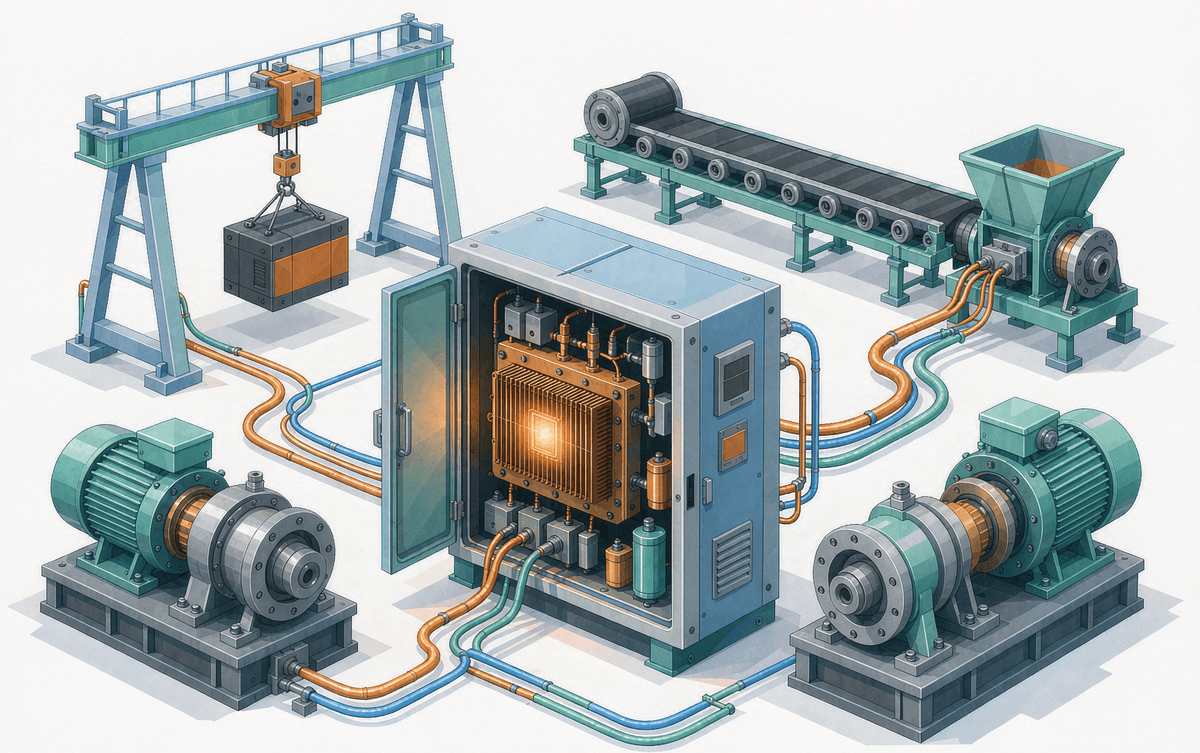
Above roughly 10 kW, at 1200–1700 V, the IGBT remains the rational default — not from inertia but from three properties that heavy industry specifically selects for. Conduction efficiency: low VCE(sat) keeps steady-state losses down on equipment that runs 24/7, which is where fans, pumps, compressors and machine-tool spindles spend their lives. Overload and fault tolerance: startup torque spikes and load dumps are routine, and a strong short-circuit withstand rating is the difference between a trip and a teardown. Maturity: the surrounding ecosystem — gate drives, protection practice, field experience — is deeply proven in cranes, mining drives and rail auxiliary converters. Typical system conversion efficiency at these ratings: 98%+ with a modern Trench FS generation, with industrial UPS and storage PCS filling out the application list alongside matched FRD co-packs.
SiC MOSFET: The Upgrade for High-Frequency Precision

Below that, where drives get smaller and demands get faster, SiC inverts the priority list. Servo axes on robots, CNC machines and automated lines live on dynamic response and current-waveform fidelity — switching at hundreds of kilohertz shrinks control-loop latency and ripple in one move. The same frequency headroom collapses passive components: a stage that ran at 10–20 kHz with IGBTs can move beyond 200 kHz, and the transformers, inductors and capacitors shrink accordingly. Efficiency gains of 5–8% over IGBT solutions in high-frequency operation come with a second bonus that matters in cramped, sealed equipment: less loss means less heatsink, and SiC's thermal conductivity means what heat remains escapes easier.
The Selection Line, Drawn Honestly

| Dimension | IGBT | SiC MOSFET |
| Voltage class | 1200–1700 V | 650–1700 V |
| Power band | ~10 kW to MW | ~1–100 kW |
| Switching frequency | Up to tens of kHz | 100 kHz+ |
| Short-circuit withstand | 10 μs class | Shorter — protection must be faster |
| Best fit | Heavy loads, overload cycling | Precision, density, high frequency |
| Cost posture | Lowest per amp | Premium returned by efficiency and size |
Two rows in that table deserve emphasis because brochures skip them. SiC's shorter short-circuit withstand is not a defect, but it moves work into the gate driver and protection design — what that means bench-side is in our short-circuit ruggedness comparison. And SiC's fast edges push dv/dt and dead-time questions that IGBT designs could ignore; both are quantified in the dead-time guide. Neither is a reason to avoid SiC; both are reasons to characterize it on your own bus before production — which is what the double-pulse method is for.
Where They Overlap — and How to Decide
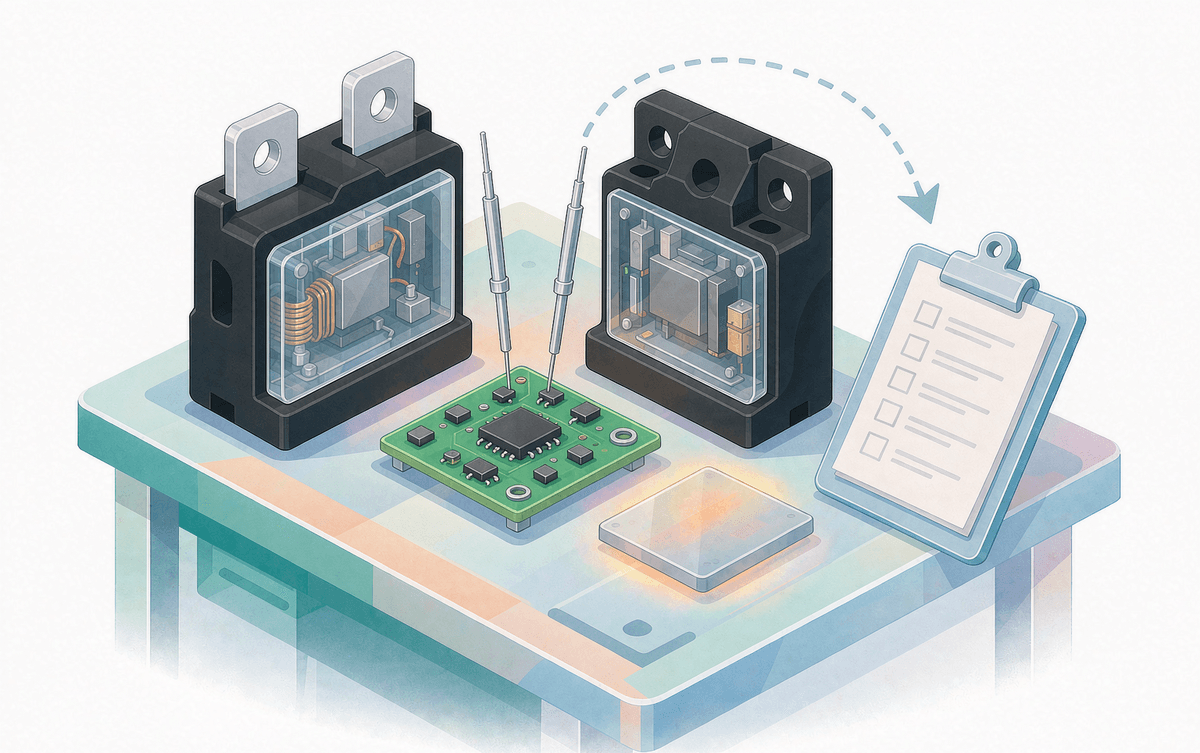
The gray zone is real: 10–100 kW drives can be built either way, and the decision becomes an arithmetic of four numbers. Efficiency value — what do saved kWh earn at your tariff and duty cycle? Thermal budget — does the enclosure force the smaller heatsink? Precision — does the process actually pay for the bandwidth? And one-time cost — gate drive, protection, layout effort. When the first three lean one way, the fourth usually follows within a couple of product generations. The heat side of the arithmetic, Rth budgets and derating, is worked through in our thermal resistance guide.
The honest summary: heavy, slow, cost-disciplined loads keep the IGBT; fast, precise, space-constrained loads move to SiC — and the middle is decided by numbers, not loyalty. Bring us your load profile and duty cycle, and we will run the loss model for both devices on the same sheet, so the recommendation arrives with its evidence attached.
