

There is a class of industrial drive that IGBT engineers quietly dread: tens of kilowatts, motor and inverter separated by a hundred meters of cable, standard motor insulation, and a resonant frequency in the commutation loop that sits uncomfortably close to a sane switching frequency. The classic answer is a sine filter at the output and a switching frequency pinned near 10 kHz — which works, but burns heat and fills the cabinet. SiC does not just do the same job faster; it changes which constraints bind. This article walks through that scenario the way it shows up on real projects, because the physics explains both why IGBT solutions stall here and what SiC buys in high-frequency inverters.
Why SiC Switches Cleaner
Start with the material: SiC's critical breakdown field is roughly ten times silicon's (2.8 vs 0.3 MV/cm). A harder material allows a much thinner drift layer for the same blocking voltage — lower on-state resistance, no conductivity modulation needed, and therefore no tail current at turn-off, the tax every IGBT pays twice per cycle. The same story holds on the freewheeling side: a SiC Schottky diode's recovery charge is a small fraction of a silicon FRD's and stays flat across the current range instead of growing with it — we covered that behavior in the FRD parameter guide. Net effect: switching energy drops hard, and unlike silicon, it stays nearly constant as junction temperature climbs.
The Real Constraint: dv/dt at the Motor Terminals
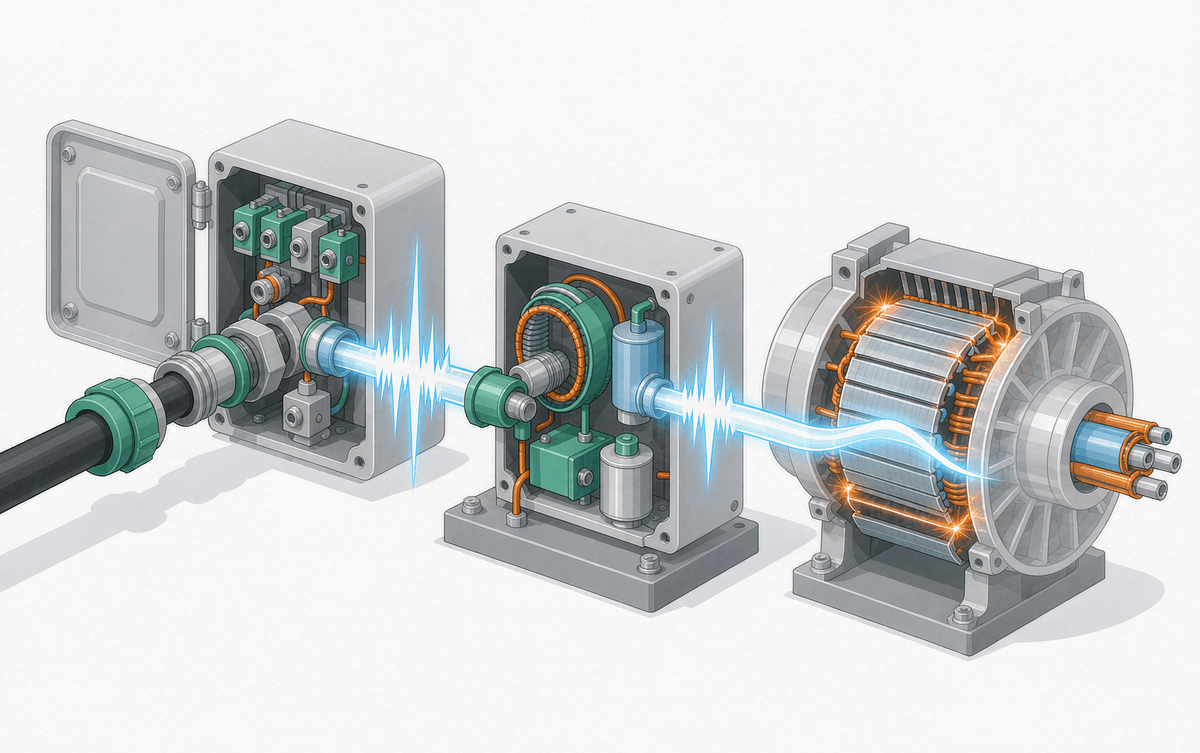
So why not just switch at 40 kHz? Because the motor is not a datasheet load. Standard industrial motor insulation tolerates roughly 1–5 kV/μs; a SiC edge can exceed 15 kV/μs depending on output signal, coupling, cable length and type. Every fast edge reflects at the motor terminals and stresses the winding insulation — premature aging, audible as nothing until it fails. That is why output filters (dv/dt or sine) exist, and why SiC designs keep them: the filter rounds the edge, lets you run unshielded cable (a real cost line over 100 m), and cuts high-frequency current in the windings, which lowers motor losses, heat and noise. The difference is how small the filter can be, which is the next section's point.
The Resonance Trap at 10 kHz
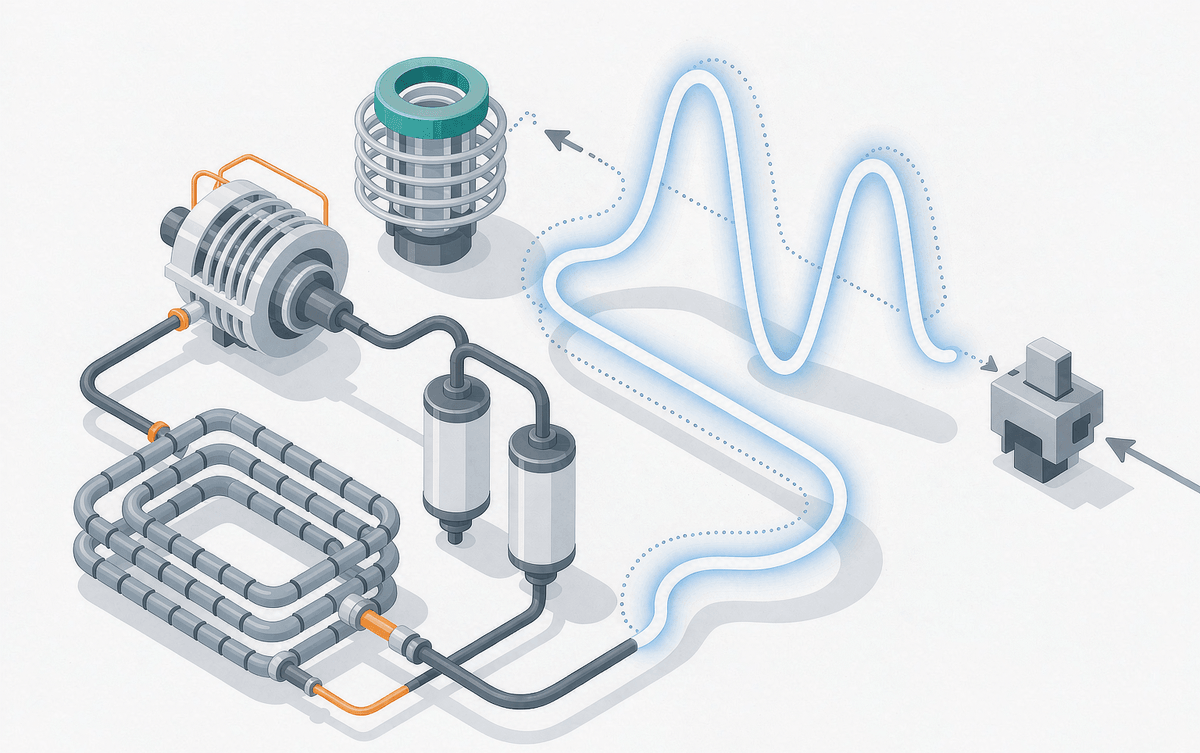
Now add the part nobody puts on the schematic: the DC-link commutation loop, motor windings and that 100 m of cable together form a resonant circuit. In this class of application its resonant frequency commonly lands near — sometimes below — the IGBT's practical switching frequency. Every switching edge then rings the tank: oscillation that hammers passive components and the motor with thermal stress. The traditional engineering answer is a compromise — a trade between thermal stress at low switching frequency and resonance excitation, patched with a sine filter. It works; it is also the reason those cabinets run hot and large.
What SiC Changes: More Frequency Margin, Smaller Filter
| Aspect | IGBT ≈ 10 kHz | SiC ≥ 16 kHz |
| Switching loss at frequency | High thermal stress | Low — energy near-flat with temperature |
| Distance to resonance | Close; edges ring the tank | Far above; excitation minimal |
| Output filter size | Large sine filter | Markedly smaller dv/dt filter |
| Motor cable | Shielded | Unshielded acceptable |
| Ripple current in windings | Higher | Lower — less motor heating and noise |
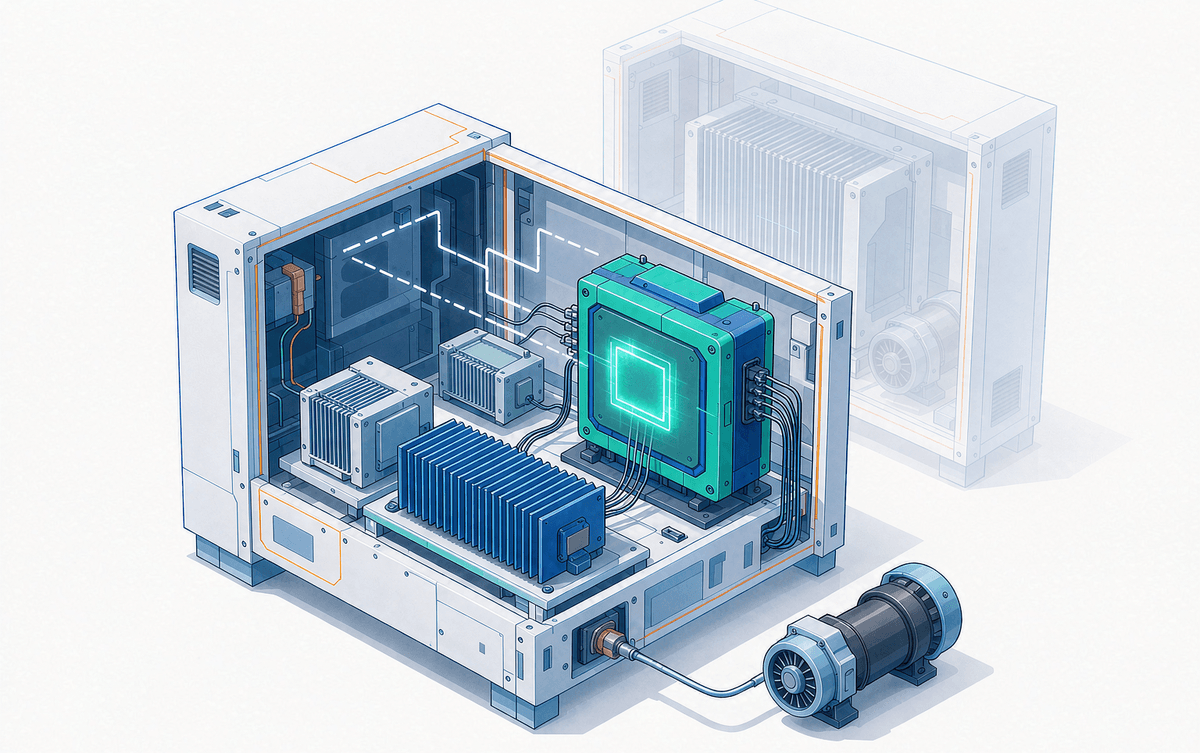
Read the table as margin, not magic: moving the switching frequency well above the resonant point stops exciting the tank, shrinks the filter, and returns some cabinet volume. The design work that remains is exactly the work SiC always demands — layout parasitics, gate-drive integrity, and characterization on your own bus. Our double-pulse characterization guide covers the bench work, and the ringing you will see there is the same phenomenon the filter is there to tame; the mitigation toolbox is in our EMI suppression notes. One honest caveat: SiC's faster, shorter edges change protection assumptions too — the ruggedness trade-offs are laid out in the short-circuit comparison.
If your drive fits the profile — two-digit kilowatts, long cable runs, a sine filter you would love to shrink — send us the cable length and motor spec. We size the filter with you rather than around you.
