

If you've worked on inverter air conditioners, washing machines, or small industrial motor drives, you've probably come across Fairchild's Motion SPM series.
The FNA41060B2, FNA41560B2, and FNA42060B2 are well-known three-phase Intelligent Power Modules (IPMs). Following Fairchild's acquisition by onsemi, changes in product availability have led many engineers to look for alternative suppliers.
One option worth checking out is the SHYSEMI SYIM656-DG, a 600V/15A Intelligent Power Module in a DIP26 package.
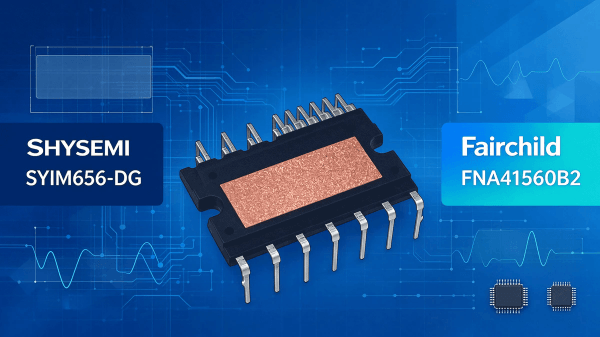
It's designed for similar three-phase inverter applications and is a potential Pin-to-Pin replacement candidate for the Fairchild FNA41560B2.
But how close are these two power modules? And what should engineers check before making the switch?Let's compare their design, electrical specifications, protection features, and applications.
1. What Do These Two IPMs Have in Common?
At the basic level, both modules are designed for three-phase motor control.
They integrate an IGBT inverter bridge, Freewheeling Diodes (FRDs), and high-side/low-side gate drivers into one package.
This helps reduce external components, save PCB space, and simplify motor drive designs.
Power Stage
Both use 600V-class IGBTs with FRDs for three-phase inverter operation.
The SHYSEMI SYIM656-DG is designed for low-power motor drive applications. However, switching losses, dv/dt, motor noise, and current harmonics still need to be compared under the same test conditions.
Gate Driver
Both use integrated high-voltage gate driver technology to control the upper and lower IGBTs.
The SYIM656-DG includes Undervoltage Lockout (UVLO) protection and cross-conduction prevention to help protect the inverter during abnormal operating conditions.
Bootstrap Supply
The SYIM656-DG supports bootstrap power supply operation for its three high-side drivers.
Engineers should still check the bootstrap circuit requirements before reusing the original PCB design.
Protection Features
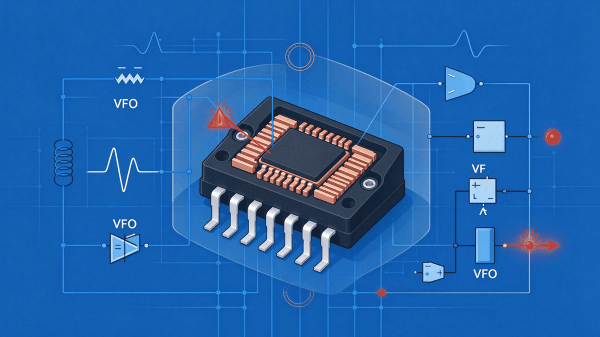
The SYIM656-DG provides:
- UVLO (Undervoltage Lockout)
- CSC overcurrent shutdown
- VFO fault signal output
- Independent low-side emitter terminals for current sensing
- Cross-conduction prevention
For temperature monitoring, there's one important difference: SYIM656-DG does not include an NTC thermistor, while SYIM656-DGT does.
Both modules can be used in BLDC and PMSM motor control systems, including PWM speed control and Field-Oriented Control (FOC).
2. SYIM656-DG vs. FNA41560B2: Key Specifications
Here's a quick comparison of the main electrical parameters.
Parameter Fairchild FNA41560B2 SHYSEMI SYIM656-DG
Package DIP26 DIP26-A
Voltage / Current 600V / 15A 600V / 15A
Power Devices IGBT + FRD IGBT + FRD
PWM Frequency Optimized for 5kHz Up to 15kHz
VCE(sat) Check original datasheet 2.1V typ., 2.4V max.
Gate Driver Supply 15V class 15V typical
Overcurrent Protection Short-circuit protection CSC threshold: 0.5V typ.
Fault Feedback Fault output VFO fault output
Temperature Sensing Depends on device version DG: No NTC; DGT: With NTC
One thing worth pointing out: the same 600V/15A rating doesn't mean the two IPMs will have exactly the same power losses or operating temperature.
For the SYIM656-DG, the datasheet specifies:
- IGBT VCE(sat): 2.1V typical at 15A
- FRD forward voltage: 1.8V typical at 15A
- IGBT junction-to-case thermal resistance: 3.2°C/W maximum
- Recommended DC bus voltage: 300V typical, 400V maximum
When evaluating a power semiconductor replacement, engineers should also compare switching losses, thermal resistance, and short-circuit performance.
These parameters can make a real difference in inverter efficiency and thermal design.
3. Can SYIM656-DG Replace FNA41560B2 Pin-to-Pin?
This is probably the first question most hardware engineers will ask.
The SYIM656-DG uses a DIP26-A package with six PWM inputs, independent low-side emitter terminals, CSC overcurrent detection, and VFO fault feedback.
These features make it a reasonable candidate for replacing an existing DIP26 IPM.
However, Pin-to-Pin compatibility means more than having the same number of pins.
Before replacing the original module, check four things:
- Package and Pinout: Compare mechanical dimensions, mounting holes, and all 26 pin assignments.
- PWM Control: Verify input polarity, logic thresholds, and minimum dead time.
- Protection Timing: Check UVLO thresholds, CSC shutdown response, and VFO fault timing.
- External Circuit: Confirm bootstrap supply, current sensing resistors, and heatsink compatibility.
According to the SHYSEMI datasheet, the SYIM656-DG has:
- Parameter: SYIM656-DG
- Minimum Dead Time: 2μs
- CSC Shutdown Delay: 1.5μs typical
- VFO Fault Clear Delay: 1.7ms typical
- CSC Threshold: 0.5V typical
If the original Fairchild design uses different control or protection settings, some adjustments and testing may be required.
So even if the module fits the existing PCB, it's still important to verify the electrical behavior before moving into production.
4. Where Can These IPMs Be Used?
Both modules target similar low-power inverter and motor drive applications.
Inverter Air Conditioners and Refrigerators
Three-phase IPMs are widely used to drive inverter compressors. Engineers usually focus on efficiency, operating temperature, motor noise, and long-term reliability.
BLDC Washing Machine Motors
For washing machine motor control, compact packaging, PWM performance, and reliable protection are important.
PMSM Water Pumps and Fans
These applications often use FOC motor control to achieve smooth speed regulation, low noise, and better energy efficiency.
Small Industrial Motor Drives
In industrial equipment, continuous load capability, thermal performance, and protection response are especially important.
The SYIM656-DG supports PWM switching frequencies up to 15kHz.
If the original inverter operates at a higher switching frequency, engineers should carefully review switching losses and thermal margins before making the replacement.
5. What Should You Test Before Switching to a New IPM?
Even with a Pin-to-Pin replacement candidate, it's worth running a few basic checks.
Step 1: Check the Hardware
Compare mounting holes, package dimensions, screw torque, power terminals, PWM inputs, fault output, and current sensing connections.
Step 2: Test the Power Supply
Apply the recommended 15V driver supply. Check the bootstrap voltage and make sure UVLO protection doesn't trigger unexpectedly.
Step 3: Check PWM Waveforms
Run the inverter without a motor load and compare the U/V/W switching waveforms, propagation delays, and dead time.
Step 4: Run a Full-Load Temperature Test
Measure module case temperature and heatsink temperature under rated operating conditions.
If the system requires built-in NTC temperature monitoring, use SYIM656-DGT and verify its thermistor characteristics.
Step 5: Verify Protection Functions
Test overcurrent shutdown, fault output timing, and MCU fault handling. For overtemperature protection, confirm the actual sensing and shutdown method used in the system.
Step 6: Check EMI and EMC
Even when two IPMs have similar electrical ratings, switching behavior can still affect conducted and radiated EMI.
Run EMC tests again and adjust the RC snubber, filtering components, or ferrite cores if needed.
6. Final Thoughts: Is SYIM656-DG a Good Fairchild IPM Alternative?
The SHYSEMI SYIM656-DG and Fairchild FNA41560B2 share several important characteristics, including their 600V/15A ratings, three-phase inverter architecture, integrated gate drivers, and target motor drive applications.
For engineers looking for a DIP26 Intelligent Power Module replacement, the SYIM656-DG is worth evaluating, especially for inverter home appliances, BLDC motor drives, PMSM systems, and small industrial inverters.
The main point is simple: check the pinout, compare the key electrical parameters, and complete the necessary thermal, protection, and EMC tests.
Looking for a replacement for the Fairchild FNA41560B2 or other DIP26 IPMs?
Contact SHYSEMI to discuss SYIM656-DG specifications, Pin-to-Pin compatibility, samples, and technical support for your motor drive project.
Datasheet: SYIM656-DG