


R&D: Jack Liu
Jack once worked at Huahong Group. With his profound expertise in wafer and IGBT module design, he led our research and development efforts.The team he led was dedicated to enhancing the heat dissipation performance, conversion efficiency and durability of electric vehicles, solar inverters and industrial motor drives.
*This article contains 1,800 words and takes 10 minutes to read.

An Intelligent Power Module (IPM) is a core power device that integrates IGBT power switches, gate drive circuitry, and protection detection circuits into a single package. It is widely used in variable-frequency drives, inverters, industrial motor drives, and similar equipment. Most IPM failures stem from electrical stress, thermal aging, mechanical stress, and power supply anomalies. The common failure modes fall into four main categories — electrical, thermal, insulation & mechanical, and drive & logic — each with distinct symptoms, root causes, and failure characteristics detailed below.
1. Electrical Failures (High-Incidence, Catastrophic)
Electrical faults are the most common and most destructive IPM failure type. They typically occur instantaneously and can directly cause module burnout and equipment shutdown. The four primary subtypes are overcurrent, short circuit, undervoltage, and overvoltage.
1.1 Sustained Overcurrent (OC)
Symptoms: The equipment frequently triggers IPM fault protection and shuts down during operation. The load exhibits insufficient torque and motor jitter, but there is no instantaneous module explosion. After a restart, the system may run normally for a brief period.
Root Causes:
- Persistent load overload, motor stall, or mechanical jamming
- Loose or poor connections in the output circuit
- Abnormal control algorithm causing continuous current above the rated threshold
- IGBT aging resulting in increased conduction losses and reduced current-carrying capacity
Failure Characteristics: Overcurrent is a sustained, chronic fault — distinct from an instantaneous short circuit. The current exceeds the rated threshold but does not reach the short-circuit limit. The IPM's internal overcurrent detection circuit triggers protection based on the configured threshold and delay time. If overcurrent events recur repeatedly, IGBT chip thermal stress increases, accelerating module aging and ultimately leading to permanent IPM failure.
In industrial inverters and motor drives, selecting products with reliable IPM overcurrent protection effectively reduces the risk of module damage caused by abnormal loads.
1.2 Instantaneous Short Circuit (SC)
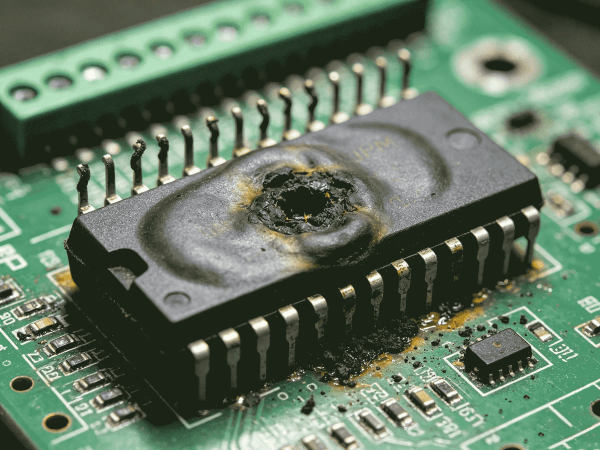
Symptoms: The equipment suddenly stops at startup or during operation. In severe cases, the module explodes or shows visible burn marks. When the fault occurs, the IPM fault feedback pin outputs a fault signal rapidly, with protection response times typically reaching the microsecond level.
Root Causes:
- Phase-to-phase or phase-to-ground short circuit at the load
- Shoot-through between the IPM upper and lower bridge arms (caused by drive signal timing errors or insufficient dead time)
- Motor winding breakdown or insulation failure
- External wiring errors or damaged cables
Failure Characteristics: An instantaneous short circuit generates a massive current surge far exceeding the rated value, making it one of the most dangerous faults in IPM applications. The IPM's integrated short-circuit detection and protection circuitry turns off the IGBT drive signal within an extremely short interval, limiting the short-circuit current duration and protecting the power chip.
For high-reliability applications such as industrial drives and servo systems, modules with high-speed IPM short circuit protection significantly improve system safety.
1.3 Drive Supply Undervoltage (UV)
Symptoms: The equipment fails to start or triggers frequent false protection trips. The load runs weakly and shows abnormal heating, with no obvious signs of short circuit or overcurrent. The fault may disappear intermittently after a restart.
Root Causes:
- Unstable IPM internal gate drive supply (typically 15 V) or excessive supply voltage drop
- Aging auxiliary power supply with insufficient load capacity
- Failed filter capacitors in the supply circuit or excessive line voltage drop
- Abnormal power-up sequence where the drive voltage has not reached the operating threshold
Failure Characteristics: When the drive voltage drops below the undervoltage lockout (UVLO) threshold, the IGBT cannot fully saturate and operates in the linear region. Conduction losses spike sharply, causing rapid module temperature rise. Prolonged undervoltage operation can directly destroy the IGBT chip. Therefore, in designing an IPM module solution, stable drive power supply design and reliable UVLO protection are essential.
1.4 DC Bus Overvoltage (OV)
Symptoms: Protection triggers during deceleration, shutdown, or grid voltage fluctuations. The entire system trips, occasionally accompanied by bulging DC bus capacitors.
Root Causes:
- Grid transient overvoltage surges or lightning strikes
- Excessive regenerative energy from the load combined with brake circuit failure
- Aging DC bus filter capacitors with degraded capacitance and reduced voltage buffering capacity
Failure Characteristics: DC bus overvoltage exposes the IPM's internal IGBTs to voltage stress exceeding the rated breakdown voltage. In severe cases, this can cause chip punch-through.
In high-voltage inverters, motor drives, and renewable energy equipment, high-breakdown-voltage, high-reliability IPM modules for industrial drives effectively improve system surge immunity.
2. Thermal Failures (Core Aging-Related Faults)
IPMs are power-dissipating devices. Prolonged high temperature and poor heat dissipation cause sustained thermal faults — the primary cause of module lifetime degradation. These are typically progressive in nature.
2.1 Overtemperature (OT)
Symptoms: The equipment triggers overtemperature protection, frequency reduction, or shutdown after running at full load for a period. It recovers after cooling, but the fault recurs with increasing frequency over time.
Root Causes:
- Heatsink dust accumulation, scaling, or cooling fan failure drastically reducing heat dissipation efficiency
- Poor IPM mounting contact, dried-out or missing thermal grease, uneven mounting pressure
- Long-term high-frequency operation with switching losses exceeding rated limits
- Excessive ambient temperature or poor ventilation
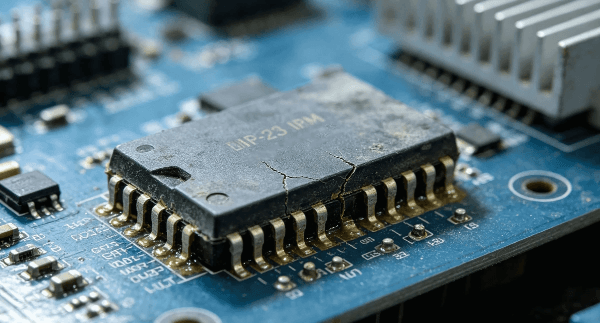
Failure Characteristics: The IPM's built-in temperature sensor monitors the baseplate temperature in real time. When the temperature exceeds the threshold, the output is immediately disabled — a self-protective response. Repeated overtemperature events can cause delamination and cracking of the chip, package, and baseplate.
2.2 Thermal Aging Failure
Symptoms: No obvious instantaneous fault occurs, but operating losses increase and equipment efficiency declines. Under light-load conditions, the IPM shows abnormal temperature rise, system stability decreases, and the module may eventually break down or fail permanently.
Root Causes:
- Long-term high-low temperature cycling, with differential thermal expansion coefficients among the package resin, DBC ceramic substrate, and copper base layer generating cyclical thermal stress
- Solder joint fatigue cracking and bond wire lift-off or degradation
Failure Characteristics: Thermal aging is a classic lifetime-degradation failure. As operating time accumulates, the module's internal thermal resistance gradually increases, reducing heat dissipation capacity and further elevating junction temperature — forming a vicious cycle of "rising temperature → increasing losses → further aging."
Therefore, when selecting an IPM intelligent power module, in addition to rated voltage and current parameters, close attention should be paid to package reliability, thermal cycling capability, and long-term operating stability.
SHYSEMI IPM modules feature optimized chip design and packaging processes, meeting the long-term high-reliability requirements of industrial drives, variable-frequency control, and renewable energy equipment.
3. Insulation & Mechanical Failures (Hidden, Persistent Faults)
Insulation and mechanical faults typically do not manifest during initial operation but accumulate gradually over long-term use. These failures are highly concealed in nature — early stages may show no obvious alarms. However, as insulation performance degrades or structural damage progresses, they can ultimately lead to leakage, breakdown, or even module explosion.
3.1 Insulation Breakdown
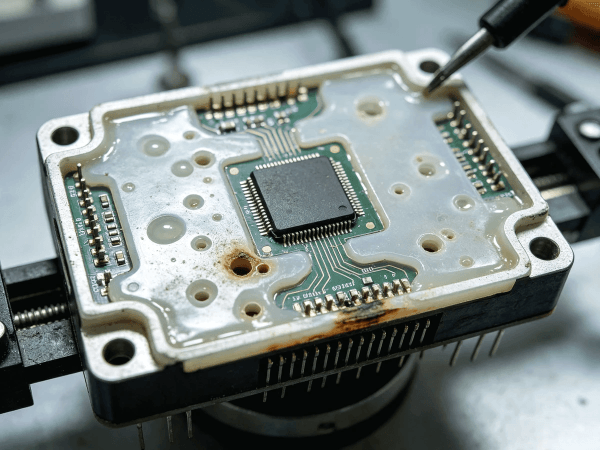
Symptoms: Equipment leakage or ground fault alarms, failed high-voltage withstand tests. The IPM module may exhibit breakdown between the chip and the heatsink baseplate, resulting in a module-to-ground short circuit.
Root Causes:
- Process defects such as voids or inclusions within the module package
- Long-term humidity, condensation, or accumulation of dust and oil contaminants reducing insulation performance
- Repeated high-voltage surges causing aging and breakdown of the insulation layer
- External mechanical force during installation causing baseplate micro-cracks
Failure Characteristics: Insulation failure is typically a progressive reliability issue. As insulation strength declines, the module's withstand voltage capability drops, increasing breakdown risk in high-voltage operating environments.
For high-voltage IPM module applications — such as industrial inverters and energy conversion equipment — the module's insulation design and reliability verification are critical factors for ensuring long-term stable operation.
3.2 Mechanical Structure Failure
Symptoms: Poor module contact and unstable operation. In some cases, abnormal motor noise and load jitter occur, with unpredictable fault timing.
Root Causes:
- Excessive mounting torque causing baseplate cracking, or insufficient torque causing poor contact
- Severe equipment vibration leading to bond wire fatigue fracture or solder joint cold joints
- Long-term vibration causing module fastening loosening
Failure Characteristics: Mechanical damage is a typical hidden fault. It may not affect normal module operation initially, but as damage propagates, it gradually compromises electrical connection reliability.
Therefore, during IPM module installation, mounting torque, thermal contact, and mechanical fastening methods must be strictly controlled.
4. Drive & Logic Failures (Control-Related Faults)
These faults do not involve damage to the power chip itself, but rather functional failures caused by anomalies in the IPM's internal drive, detection, or logic circuits — or by abnormal external control signals.
4.1 Drive Signal Anomaly
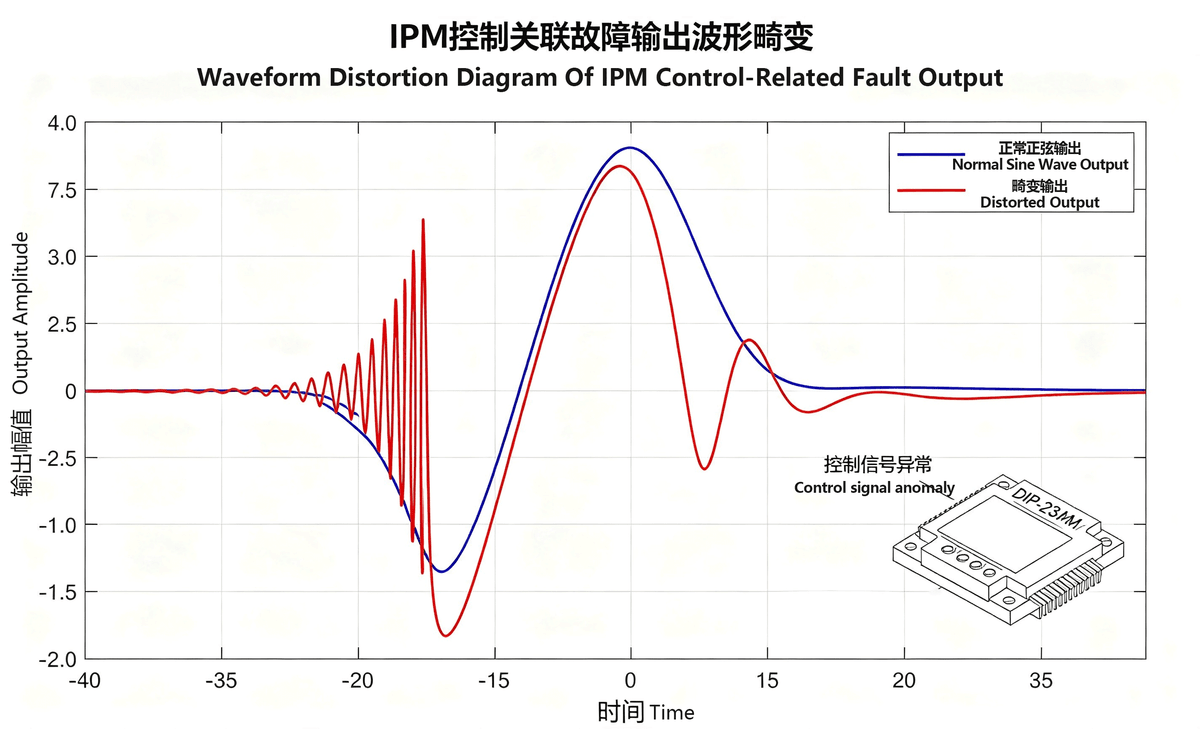
Symptoms: No module output or non-functioning load, or distorted output waveforms and abnormal motor operation — without overcurrent or overtemperature alarms.
Root Causes:
- External PWM signal interference or waveform distortion
- IPM internal drive IC failure or level-shift circuit malfunction
- Poor signal line shielding and crosstalk interference
Failure Characteristics: A drive signal anomaly prevents the IGBT from switching according to design requirements. If abnormal drive pulses persist, they may further cause upper-lower bridge arm shoot-through, abnormal heating, or even power device damage.
Therefore, a high-reliability IPM solution requires a stable drive design and comprehensive anti-interference capability.
4.2 Fault Feedback Anomaly (False Alarms / No Feedback)
Symptoms: The equipment frequently reports IPM faults under normal operating conditions, or the module is already damaged but no fault signal is output.
Root Causes:
- IPM internal fault detection circuit or FO (Fault Output) feedback pin anomaly
- Failure of external sampling resistors or filter circuits
- Abnormal signal acquisition by the main controller
Failure Characteristics: Fault feedback anomalies increase equipment maintenance difficulty. Comprehensive diagnosis requires an oscilloscope, current probe, and protection signal waveform analysis.
During IPM module troubleshooting, both the IPM itself and the peripheral control circuit must be checked simultaneously to avoid misdiagnosing module failure.
5. Summary of IPM Failure Modes
Among these, short circuit, overtemperature, and undervoltage are the three most common field failures. The majority of permanent IPM damage results from repeated triggering of these three fault types or from transient surges.
In industrial drives, inverters, and renewable energy equipment, selecting an IPM module with comprehensive protection functions and high reliability is a critical measure for improving system stability and reducing maintenance costs.
SHYSEMI High-Reliability IPM Solutions
As a specialized power semiconductor supplier, SHYSEMI IPM modules integrate high-performance IGBT chips, optimized gate drive design, and comprehensive protection functions. They feature low conduction losses, low switching losses, and high reliability — helping customers improve system efficiency while reducing long-term operating risks.
If you are looking for high-reliability IPM intelligent power modules for industrial inverters, motor drives, HVAC systems, servo systems, or renewable energy equipment, contact us for product selection support, technical documentation, and sample testing programs.
The SHYSEMI team provides professional IPM selection guidance and customized power semiconductor solutions tailored to your application requirements.
Related Products