

In recent short-circuit testing carried out in a Topband air-conditioner solution, the SHYSEMI SIP35-package SYIM776C-SST 600V/20A IPM passed the short-circuit test three consecutive times.
During the test, the oscilloscope recorded a peak short-circuit current of approximately 82A — about 4.1 times the 20A rated current. From the moment the short-circuit current reached about 30A to the point where the FO fault signal at the MCU side fell below 1V, the measured time was approximately 3μs.
In addition to three consecutive full short-circuit tests, repeated tests were also performed on the U-N, V-N and W-N short-circuit paths. These results provide application-level verification of the short-circuit protection and abnormal-condition reliability of the SYIM776C-SST in a real air-conditioner compressor inverter system.
In the variable-frequency drive system of an air-conditioner compressor, an IPM must not only deliver the required power output during normal operation, but also cope with abnormal conditions such as startup faults, load anomalies, and short circuits between bridge arms or phases. For air-conditioner customers, IPM selection therefore depends not only on rated voltage, current, power loss and thermal performance — short-circuit protection and reliability under abnormal conditions are just as important.
1. Why Must an Air-Conditioner IPM Undergo Short-Circuit Testing?
The outdoor unit of an inverter air conditioner typically uses a three-phase inverter to drive the compressor motor. The IPM integrates IGBT power devices, high-voltage gate drive circuits, and protection functions including over-current, under-voltage and temperature protection.
During actual operation, the system may encounter various abnormal conditions, for example:
- Shoot-through of the upper and lower bridge arms
- U/V/W phase-to-phase short circuits
- P-U, P-V and P-W short circuits
- U-N, V-N and W-N short circuits
- Abnormal compressor startup
- Sudden load changes or load anomalies
- Control signal faults causing false bridge-arm turn-on
Once a short circuit occurs, the current rises far faster than in normal operation. At this moment, the IPM must accomplish two things simultaneously: first, identify the short-circuit fault quickly; second, withstand the transient current and voltage stress brought by the short-circuit current until the protection action is completed.
Therefore, judging the short-circuit capability of an IPM cannot be based merely on "whether it has over-current protection". What really matters is the entire process — from fault occurrence and current detection, to protection signal output, and finally to the power devices completing turn-off.
2. A 20A IPM — Why Does Short-Circuit Capability Still Matter?
Under normal operating conditions, the working current of a 20A IPM stays within its rated range. But when a short circuit occurs in the inverter, the current can rise very rapidly within an extremely short time. Possible abnormal conditions in an air-conditioner compressor drive system include:
- Shoot-through of the upper and lower bridge arms
- U/V/W phase-to-phase short circuits
- P-U, P-V and P-W short circuits
- U-N, V-N and W-N short circuits
- Abnormal compressor startup
- Load anomalies
- Control signal faults
After a short circuit occurs, the IPM needs to quickly detect the abnormal current, output a fault signal to the control system through its internal protection circuit, and at the same time control the power devices to complete turn-off. The whole process takes place on a microsecond time scale.
The short-circuit performance of an IPM is therefore the combined result of the power chip, drive circuit, protection circuit, package structure and system design.
3. SYIM776C-SST Short-Circuit Test Results
This test was carried out in an air-conditioner compressor inverter application environment. The main test data obtained are as follows:
| Test Item | Result |
| IPM rated current | 20A |
| Short-circuit peak current | ≈82A |
| Peak current / rated current | ≈4.1× |
| Short-circuit current observation point | ≈30A |
| 30A to MCU-side FO < 1V | ≈3μs |
| Consecutive full short-circuit tests | 3 passed |
| Repeated U-N short-circuit tests | 5 passed |
| Repeated V-N short-circuit tests | 5 passed |
| Repeated W-N short-circuit tests | 5 passed |
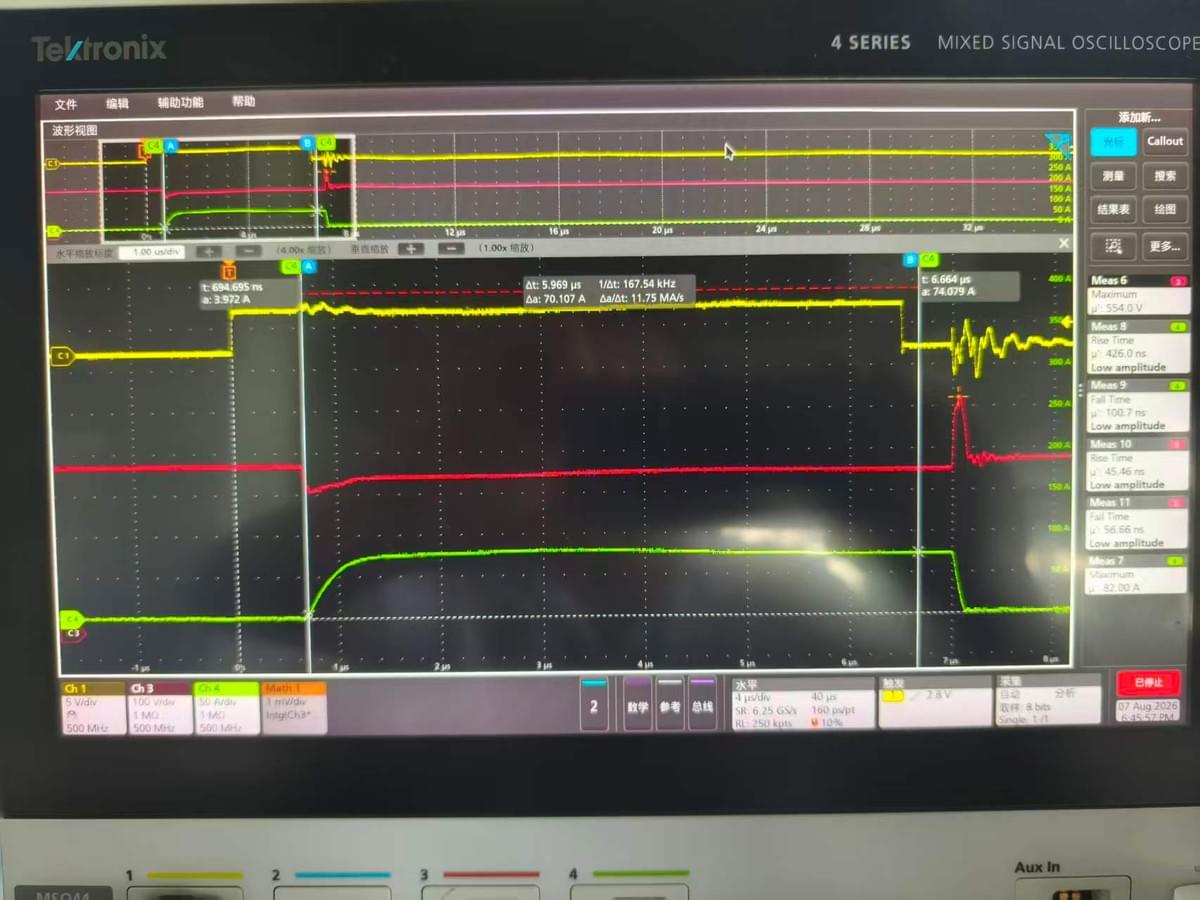
Among these results, passing three consecutive short-circuit tests is a key outcome of this verification. In real applications, customers care not only about whether the protection completes on a single fault event, but also whether the device can continue operating normally after experiencing short-circuit transient stress. The SYIM776C-SST remained normal throughout the consecutive tests, providing further evidence for reliable operation in air-conditioner compressor applications.
3.1 Short-Circuit Peak Current Reached ≈82A
The rated current of the SYIM776C-SST is 20A. In this short-circuit test, the oscilloscope recorded a peak short-circuit current of approximately 82A: 82A ÷ 20A ≈ 4.1. In other words, the transient short-circuit current observed during the test was about 4.1 times the rated current.
It should be noted that 82A is the transient peak recorded during the test, and does not represent the continuous operating current capability of the SYIM776C-SST. For an IPM, this type of test is mainly used to observe the transient electrical stress after a short circuit occurs, and whether the protection mechanism can act in time before the power devices are exposed to excessive stress. When evaluating short-circuit performance, the following must therefore be considered together: peak short-circuit current, short-circuit detection, fault signal response, and the final protection and turn-off behavior.
3.2 ≈3μs from 30A to the MCU Fault Signal
Besides the peak short-circuit current, this test also observed the fault-signal response of the IPM. From the point where the short-circuit current reached about 30A to the point where the FO signal at the MCU side fell below 1V, the measured time was approximately 3μs.
This result reflects the response speed of the SYIM776C-SST from over-current condition to fault signal output. Note that this 3μs corresponds to "short-circuit current reaching 30A → MCU FO < 1V", not the complete IGBT turn-off time. In technical documentation, the more accurate expression is: approximately 3μs from the short-circuit current reaching 30A to the FO signal falling below 1V at the MCU.
This kind of test data helps customers better understand the short-circuit detection and fault response characteristics of the IPM, and evaluate them together with their own MCU control strategy, PWM shut-off logic and overall system protection timing.
3.3 Three Consecutive Short-Circuit Tests Passed
Compared with a single short-circuit verification, a noteworthy feature of this test is repetition. The SYIM776C-SST completed three consecutive full short-circuit tests and remained in normal working condition. In addition, five repeated tests were performed on each of the U-N, V-N and W-N short-circuit paths.
For air-conditioner compressor drive systems, such repeated tests provide further observation of whether the IPM's protection function and device condition remain stable after short-circuit transients. It should be emphasized that "passing three consecutive tests" is a result of this application verification, and does not represent a repeat short-circuit rating defined in the product datasheet. Actual product designs should still implement short-circuit protection according to specific application conditions, bus voltage, load, current, PWM control scheme and thermal conditions.
3.4 Verified in a Real Compressor Drive Environment
This test was not a bench experiment on a bare IGBT chip; it was a verification of the SIP35 IPM inside an air-conditioner compressor inverter solution. The test covered different short-circuit paths, including P-U / P-V / P-W, U-V / U-W / V-W, and U-N / V-N / W-N.
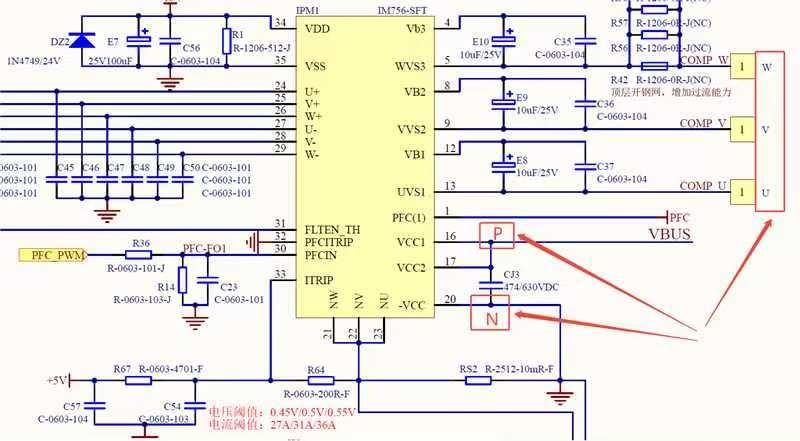
When a short-circuit fault occurs in a real inverter system, the IPM is simultaneously affected by DC-link energy, load condition, operating current, PCB parasitic parameters and other factors. Short-circuit testing in the application environment can therefore further verify the protection design of the IPM at the system level. For air-conditioner customers, these test results can also serve as a reference during device selection and solution validation.
4. International Benchmark of 20A/600V-Class IPMs
Based on product voltage, current, topology and application, the following comparison framework can be formed:
| Vendor | Product | Voltage | Current | 3-Phase IPM | Main Applications | Benchmark |
| SHYSEMI | SYIM776 | 600V class | 20A | ✓ | Air-conditioner compressor | Device under test |
| Infineon | IM06B20AC1 | 600V | 20A | ✓ | Residential AC / motor control | Highly matched |
| Mitsubishi Electric | PSS20S71F6 | 600V | 20A | ✓ | Air conditioner | Highly matched |
| Mitsubishi Electric | PSS20S73F6 | 600V | 20A | ✓ | Air conditioner / motor | Highly matched |
| Fuji Electric | 6MBP20XSF060-50 | 600V | 20A | ✓ | Air conditioner / inverter | Highly matched |
| Fuji Electric | 6MBP20VAA060-50 | 600V | 20A | ✓ | Air conditioner / servo / inverter | Highly matched |
| onsemi | FSBB20CH60C | 600V | 20A | ✓ | Motor / inverter | Highly matched |
| onsemi | NFAM2065L4B | 650V | 20A | ✓ | 3-phase inverter | 650V-class reference |
5. From Datasheet Parameters to Application Verification
For IPM selection, the rated voltage and current in the datasheet are the baseline parameters. But once the product enters a real air-conditioner system, customers need to look further: How fast does the IPM detect a fault? How does it respond to a short-circuit event? Can the module continue to work normally after multiple fault events?
The test of the SYIM776C-SST in the Topband air-conditioner solution provides a set of measured data for these questions:
- 20A rated current
- ≈82A short-circuit peak current
- ≈4.1× rated current
- ≈3μs from 30A to MCU FO < 1V
- 3 consecutive short-circuit tests passed
- Repeated U-N / V-N / W-N tests passed
These results demonstrate the short-circuit protection and abnormal-condition handling capability of the SHYSEMI SIP35 IPM in air-conditioner compressor inverter applications. For customers developing air-conditioner compressors, motor drives and other three-phase inverter products, these application verification data can also serve as a reference for IPM selection and solution evaluation.
SHYSEMI will continue to verify its IPM products under real application conditions, helping customers build more reliable and more efficient variable-frequency systems.
